Window Inserts vs Full-Frame Replacement: Which One You're Being Quoted
Got two window quotes that are thousands apart on the same house? The gap is usually not markup, it's two different jobs. An insert nests a new window inside your existing frame; a full-frame replacement tears the whole thing out to the studs. One costs you glass; the other costs you a day and finds what's rotting behind the trim.
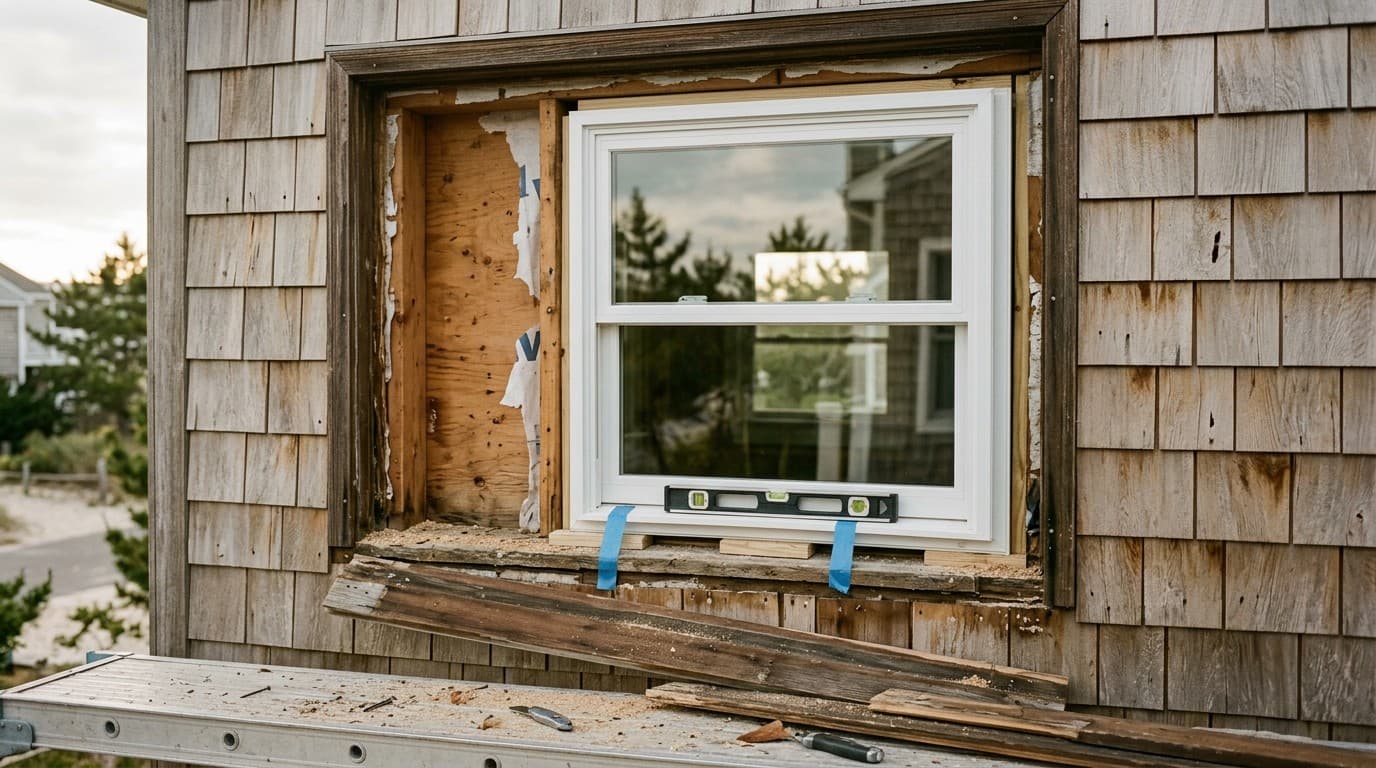
An insert (also called a pocket window) sets a new window inside your existing frame and trim, so it is faster and cheaper but costs you 1 to 3 inches of glass on each side and leaves whatever is behind the old frame untouched. A full-frame replacement removes the window down to the rough opening, so it is more expensive and slower but is the only option once the frame or sill has rot. Two quotes thousands apart on one house are usually quoting these two different jobs.
Written for Ocean County shore homes specifically: Forked River, Lacey, Bayville, Barnegat, Waretown, Manahawkin, Toms River and Brick, plus the Monmouth shoulder towns of Howell, Wall and Manasquan, where salt air and wind off the bay age a window from the frame out.
Home Pro Remodeling is a GAF Certified exterior contractor based in Forked River, NJ HIC licensed 13VH08300200, working Ocean and Monmouth County only. When a homeowner calls us confused by two window quotes that are far apart, the confusion almost always comes from one word nobody explained: whether the price is for an insert or a full-frame replacement. They are not two grades of the same job. They are two different jobs, and the cheaper one is usually not a better deal, it is a smaller scope. Here is how to tell which one you are holding. If you are not yet sure the window even needs replacing, start with the signs you actually need new windows, since a lot of what looks like a dead window is a seal or a balance.
Two Quotes, One House, and a Price Gap That Is Not Markup
When one window quote comes in well under another on the same house, the first thing to check is not the price, it is the method. Insert windows and full-frame replacements can differ by a large margin per opening because one leaves your existing frame in the wall and one removes it. A contractor quoting inserts is pricing a window and an afternoon. A contractor quoting full-frame is pricing a window, a tear-out, new flashing, new trim, and whatever the wall has been hiding. Same house, same number of openings, genuinely different amounts of work.
Neither is a scam. The mistake is comparing the two as if they are the same product at two prices. Before you weigh a single dollar figure, you have to know which job each quote describes, because the "expensive" one may be the only one that actually fixes what is wrong.
What an Insert Actually Replaces, and What It Leaves in the Wall
An insert replaces the moving parts of the window and nothing else. The old sashes come out, and a fully built new window unit is set into the existing frame, fastened, insulated at the perimeter, and sealed. Your original frame, the exterior trim, the interior casing, and the sill all stay exactly where they are. That is what makes it fast, often one opening in under an hour, and clean, with no disturbance to your siding or your interior walls.
Here is the trade-off nobody mentions at the quote: because the new unit nests inside the old frame, everything the old frame was hiding stays hidden. If the frame is sound, that is fine, and an insert is a genuinely good, efficient choice. If the frame or the sill has taken on water, an insert seals the problem inside the wall where it keeps going. An insert is the right tool for a good frame with tired sashes. It is the wrong tool for a compromised frame, and it cannot tell the difference on its own.
When the Frame Is the Problem and an Insert Cannot Fix It
A full-frame replacement is the right call whenever the frame, sill, or surrounding wall is part of the problem, because it is the only method that removes them. Full-frame takes the window out down to the rough opening in the framing, which exposes the sill, the studs, and the wall around the opening. That lets the crew replace rotted wood, install a proper sill pan and flashing, and set a brand-new, correctly sized window into a clean, dry opening.
The signs that push a job from insert to full-frame:
- Soft or spongy sill. Press the interior sill and the frame corners. Give, softness, or a dull sound means water has been sitting in the frame, and no insert fixes that.
- Water stains or peeling paint on the interior casing. That is moisture coming through or around the frame, not just the glass.
- Frame that is out of square. If the old frame has racked, an insert set inside it inherits the same distortion.
- Air or water intrusion you can feel or see. Drafts at the frame edge, not the sash, point at the frame-to-wall connection, which an insert never touches.
- You are re-siding anyway. If the siding is coming off, the wall is already open, and full-frame becomes the obvious, better-value moment to do it right.
Rot, Sills, and What We Find Behind Shore-House Trim
On a shore house, the reason full-frame comes up so often is that windows here fail from the sill and the frame outward, exactly the part an insert leaves alone. Salt air holds moisture against the fastener line and the wood behind your trim. Wind-driven rain off the bay finds the smallest gap at the top corners of a window and runs down inside the frame. Long humid summers mean anything that gets in dries slowly, if at all. The result is that a window can look fine from the street and be rotting from the sill up.
When we pull a window full-frame on a house in Forked River or Barnegat, the most common find is a sill and lower frame that is soft, and sheathing below the opening that has darkened and gone punky. You cannot see any of it until the window is out. This is the single biggest argument for knowing which quote you have: an insert over a rotten sill looks perfect on install day and keeps rotting behind the new unit, which is the same "pay twice" trap that catches homeowners on siding, covered in our guide to siding repair vs replacement on a shore house. The same water paths that rot a sill rot the soffit and fascia above, which is why soffit and fascia rot in Ocean County so often shows up on the same house.
Glass Size: The Thing Nobody Warns You an Insert Costs You
The hidden cost of an insert is glass. Because a pocket window sets a whole new frame inside your existing frame, the new window is smaller than the opening by the thickness of both frames stacked, and you lose roughly 1 to 3 inches of visible glass on each dimension. On a big picture window facing the water, that is a noticeable band of daylight and view traded away for the convenience of not touching the trim.
How much it matters depends on the window:
- Small or high windows, like a bathroom or a hallway, lose glass nobody was looking through anyway. Insert is usually fine.
- Main-view windows, especially bay-side or ocean-side, are where the lost inches show, and full-frame keeps the opening at full size.
- Rooms of matching windows can look off if some are full size and some are inset, so it is worth deciding by room, not by window.
Full-frame keeps every inch of the original opening because it replaces the whole assembly. That is part of what you are paying the difference for, not just the labor.
How to Read Which One Your Quote Is Describing
You can usually tell an insert quote from a full-frame quote by the words on the page, once you know what to look for. Here is the side-by-side.
| Insert / pocket window | Full-frame replacement | |
|---|---|---|
| What comes out | Just the sashes; frame and trim stay | The entire window down to the rough opening |
| Words on the quote | "insert," "pocket," "retrofit," "sash replacement" | "full-frame," "new construction," "tear-out to the studs," "new flashing/sill pan" |
| Handles rot? | No, it seals it in | Yes, exposes and replaces it |
| Glass size | Loses 1 to 3 inches per side | Keeps the full opening |
| Time per opening | Often under an hour | Several hours, more if rot is found |
| Disturbs siding/trim? | No | Yes, exterior trim and flashing are redone |
| Best for | Sound frame, tired sashes | Any rot, out-of-square frame, re-side, full-size view |
If a quote does not say which method it is, that is the first question to ask, before price. A quote that will not put the method in writing is a quote you cannot compare, and it is the same discipline that separates a real roof quote from a cheap one in why roofing quotes vary so much.
What a Window Job Actually Looks Like Day to Day
Knowing the method also tells you what your day looks like. An insert job is quiet and quick: the crew works opening by opening from inside, each window is out and the new one in within about an hour, and there is no exterior work and almost no mess. A whole-house insert job can be a single day.
A full-frame job is a bigger operation. Each opening is taken out to the framing, so there is exterior work, flashing, new trim, and the real possibility that opening a window reveals rot that has to be repaired before the new unit goes in. That is not a surprise upcharge if the quote handled it right; a good full-frame quote states a per-opening allowance for rotted sill or sheathing and a sign-off step, the same way a good roof quote states a per-sheet decking rate, because nobody can see behind the trim until the window is out. Expect a full-frame job to run longer and to include a walk of anything found along the way.
Ready to figure out which quote you actually have?
Send us the window quotes you are weighing, from any contractor in Forked River, Lacey, Bayville, Barnegat, Toms River, Brick, Manahawkin, Waretown, Howell, Wall, or Manasquan, and we will tell you whether each one is an insert or a full-frame job and what that means for your house, no charge. Home Pro Remodeling is a GAF Certified exterior contractor, NJ HIC licensed (13VH08300200), serving Ocean County and Monmouth County only. See what a proper window replacement includes, request a free estimate, or call (732) 703-7808, you get us directly, not a call center.
Frequently Asked Questions
What is the difference between an insert window and a full-frame replacement?
An insert, or pocket window, sets a new window inside your existing frame and trim, so only the sashes come out and the frame stays. A full-frame replacement removes the entire window down to the rough opening in the framing, exposing the sill and wall. Inserts are faster and cheaper but leave the frame and anything wrong with it in place; full-frame is more work but is the only method that can replace a rotted sill or frame.
Why is one window quote so much cheaper than the other?
Usually because the cheaper quote is for inserts and the higher one is for full-frame replacement, which are two different amounts of work on the same house. An insert is a window and an afternoon; full-frame adds tear-out, new flashing and sill pan, exterior trim, and any rot repair the opening reveals. Confirm which method each quote describes before comparing the numbers, because they are not the same product at two prices.
Do insert windows make the glass smaller?
Yes. Because a pocket window nests a new frame inside your existing frame, you lose roughly 1 to 3 inches of visible glass on each dimension. On small or high windows nobody notices. On a main-view or water-facing window it is a real reduction in daylight and view, which is one reason full-frame is worth the difference on the windows you actually look through.
Can I use insert windows if my window frame is rotted?
No. An insert seals a new unit inside the old frame, so a rotted sill or frame stays in the wall and keeps deteriorating behind the new window, which looks perfect on install day and fails later. Once there is rot, full-frame replacement is the only method that fixes it, because it removes the frame and sill and lets us dry and rebuild the opening before setting the new window.
How do I know if my window frame has rot before getting quotes?
Press the interior sill and the lower frame corners for softness or a spongy feel, look for water stains or peeling paint on the interior casing, and check whether the window is still square and closes evenly. Drafts you feel at the frame edge rather than the sash, and any musty smell on that wall, are also signals. Any of these means ask specifically about full-frame, because an insert cannot address a compromised frame.
Are insert or full-frame windows better for a Jersey Shore house?
It depends on the frame, not a blanket rule. Shore windows fail from the sill and frame outward because of salt air and wind-driven rain, so full-frame is common here whenever there is rot or you are re-siding. But on a house with sound frames and tired sashes, inserts are an efficient, correct choice. The right answer is decided window by window after someone checks the frames, not by the lower number.