5-Inch vs 6-Inch Gutters: Which Size Your Shore Home Needs
5-inch gutters suit most ranches and capes. Go 6-inch for steep roofs, valleys and long runs. And upsize the downspouts first: that fixes most overflow.
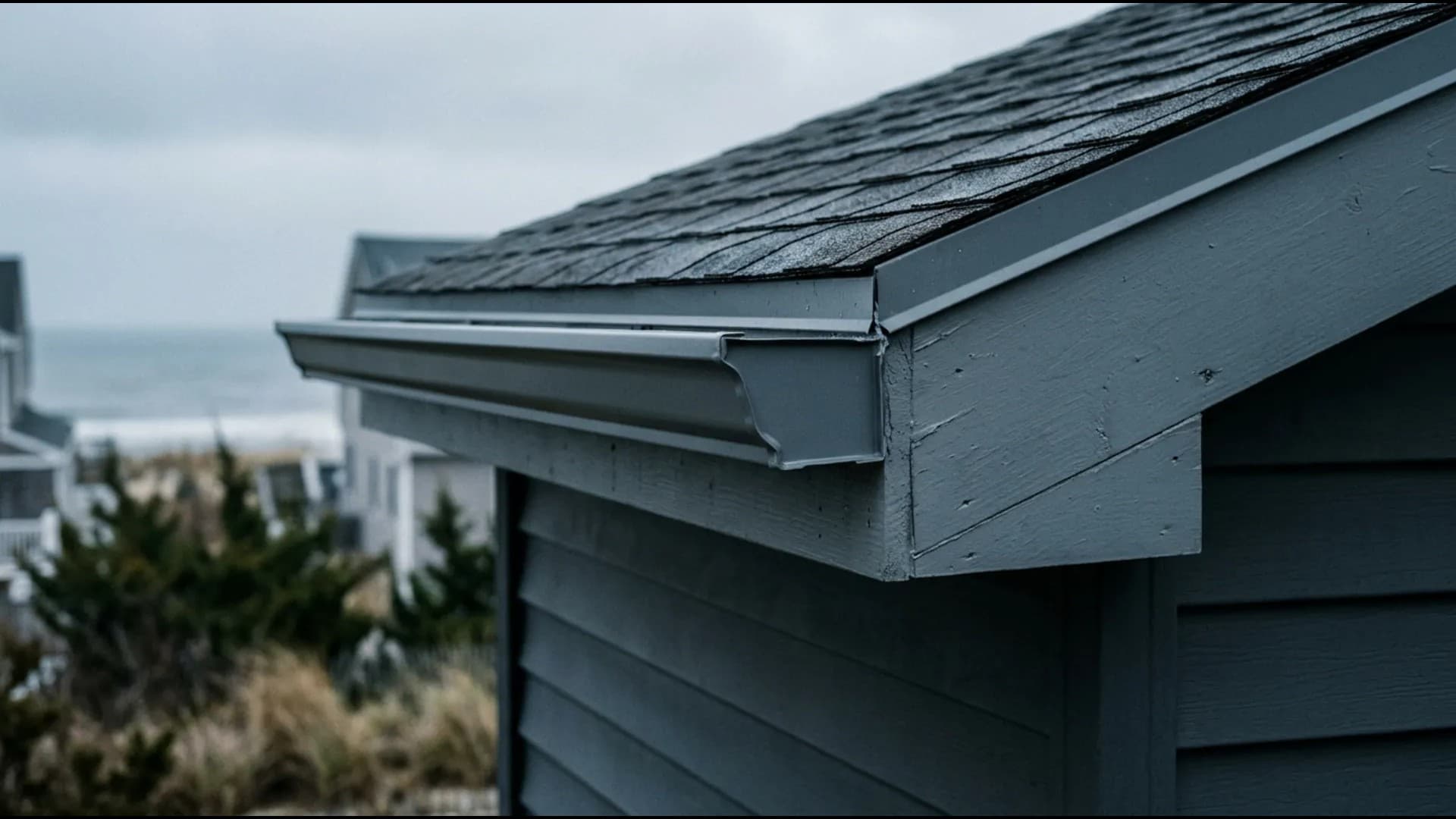
Five-inch gutters are fine on most single-story ranches and capes in Ocean and Monmouth County. Go to six-inch when a big roof plane drains into one long run, when the roof is steep, when a valley dumps straight into the gutter, or when you're under heavy oak and pine. And before you pay for a bigger gutter, look at the downspouts, because on most of the overflowing gutters we're called to, the gutter was never the bottleneck. The outlet was.
We get asked this on almost every gutter estimate from Toms River to Oakhurst, usually by someone whose gutters overflow in a hard summer storm and who has been told six-inch is the fix. Sometimes it is. Here's how we decide.
What actually decides the size
A gutter has one job, which is to carry the water off the roof plane above it to a downspout before it spills over the front. How much water arrives depends on three things: how much roof drains into that run, how steep the roof is, and how hard it rains.
Roof area per run. Not the size of the house. A 2,400 square foot colonial with four short runs and four downspouts can be fine on five-inch. A ranch with one long back run collecting the whole rear slope might not be.
Pitch. A steeper roof catches more wind-driven rain and sends it down faster. The industry sizing tables bump the effective roof area by somewhere between 5 and 30 percent as the pitch climbs, which is why the same footprint can need a bigger gutter on a steep colonial than on a low ranch.
Rain. Our sizing assumes the 2 to 3 inch per hour downpours that summer cells and tropical systems put over the shore, not an average rain. Gutters don't fail in average rain.
Upsize the downspout first
This is the part we'd push back on hardest. A gutter can only empty as fast as its downspouts take the water. The standard downspout is 2 by 3 inches, which is 6 square inches of opening. Our shore spec is a 3 by 4 inch downspout, which is 12 square inches, double the opening, plus a downspout roughly every 20 to 25 feet of run instead of the 30 to 40 feet a lot of installers use.
Do that on a five-inch system and a lot of overflow problems simply stop. Each added downspout runs about $50 to $150, which is a fraction of the difference between five and six-inch over a whole house. If you're getting a quote for six-inch gutters and nobody has mentioned downspout size or spacing, ask before you sign.
When six-inch is the right call
- A long run with one outlet. When the layout won't let you add a downspout in the middle, say over a deck or a walkway, a bigger gutter buys the capacity the second outlet would have.
- Steep roofs. Above about an 8 in 12 pitch, water comes off fast enough to overshoot a five-inch gutter in a hard rain, even when the downspouts are keeping up.
- Valleys. Where two roof planes meet, the valley concentrates water into one point on the gutter. Valleys over a front entry are where we see five-inch gutters overflow first.
- An upper roof draining onto a lower one. The second-story water lands on the first-story roof and arrives at that lower gutter all at once.
- Heavy tree cover. Under oaks and white pines, a six-inch gutter keeps flowing longer between cleanings and takes a gutter guard better.
When five-inch is all you need
Most single-story homes with a moderate pitch, short runs and properly spaced 3 by 4 downspouts. That covers a lot of the Brick, Lacey and Berkeley housing stock. Putting six-inch on a house that doesn't need it isn't wrong, just money spent on capacity the roof will never use, and the bigger profile is more visible on a small facade.
Either way we run aluminum gutters formed in one continuous piece on site, .032 gauge on most homes and .040 on waterfront houses or heavy runoff, hung with hidden hangers into the rafter tails every 24 inches. The size changes. The way it's hung doesn't.
How we decide on your house
We walk every run, note which roof planes drain into it, check the pitch and look for valleys and upper roofs dumping down. Then we tell you which runs need six-inch, if any, and where the downspouts go. Plenty of houses end up mixed: five-inch on the short front runs, six-inch on the back run under the valley. That's a perfectly normal answer.
The broader pricing is in gutter installation cost in NJ, and one-piece vs sectional gutters covers the material side. If your gutters overflow every storm and you want someone to tell you why, our gutter service page is the place to start.
Frequently Asked Questions
Do 6-inch gutters really hold more water than 5-inch?
Yes. A six-inch K-style gutter carries noticeably more water than a five-inch one, which matters on steep roofs, long runs and under valleys. But a gutter only empties as fast as its downspouts, so a five-inch system with 3 by 4 inch downspouts every 20 to 25 feet often outperforms a six-inch system on undersized 2 by 3 downspouts.
Can I mix 5-inch and 6-inch gutters on the same house?
Yes, and it's common. We often run five-inch on short front runs and six-inch on a back run that collects a whole rear slope or sits under a valley. Each run is sized to the roof plane draining into it.
Are 6-inch gutters better with gutter guards?
Generally, yes. The wider trough keeps flowing longer between cleanings under oaks and pines, and it takes a guard with less loss of capacity. Under heavy tree cover we usually recommend six-inch for the runs that catch the most debris.