Leaking Where the Siding Meets the Roof: Who to Call
It is almost always flashing, which sits in the seam between two trades, and that is why the roofer and the siding guy are giving you different answers. The three pieces of metal that should be there, how to tell which one failed before anything comes off, and what a correct repair names in writing.
It is almost always a flashing job, and flashing lives in the seam between the two trades, which is exactly why you are getting different answers from different contractors. Water showing up where a wall meets a roof is rarely the shingles failing and rarely the siding failing. It is the metal that is supposed to tie them together, and on the houses we see in Ocean County it is either installed wrong, installed short, or not there at all. Updated October 2026.
We get this call a lot, usually in the second week of a wet stretch. Somebody has a stain on an interior wall or a ceiling corner, a roofer told them it was siding, a siding guy told them it was roofing, and both of them were half right.
The three pieces of metal that should be there
Where a sloped roof runs into a vertical wall, there are three things doing the work, and most leaks are one of them.
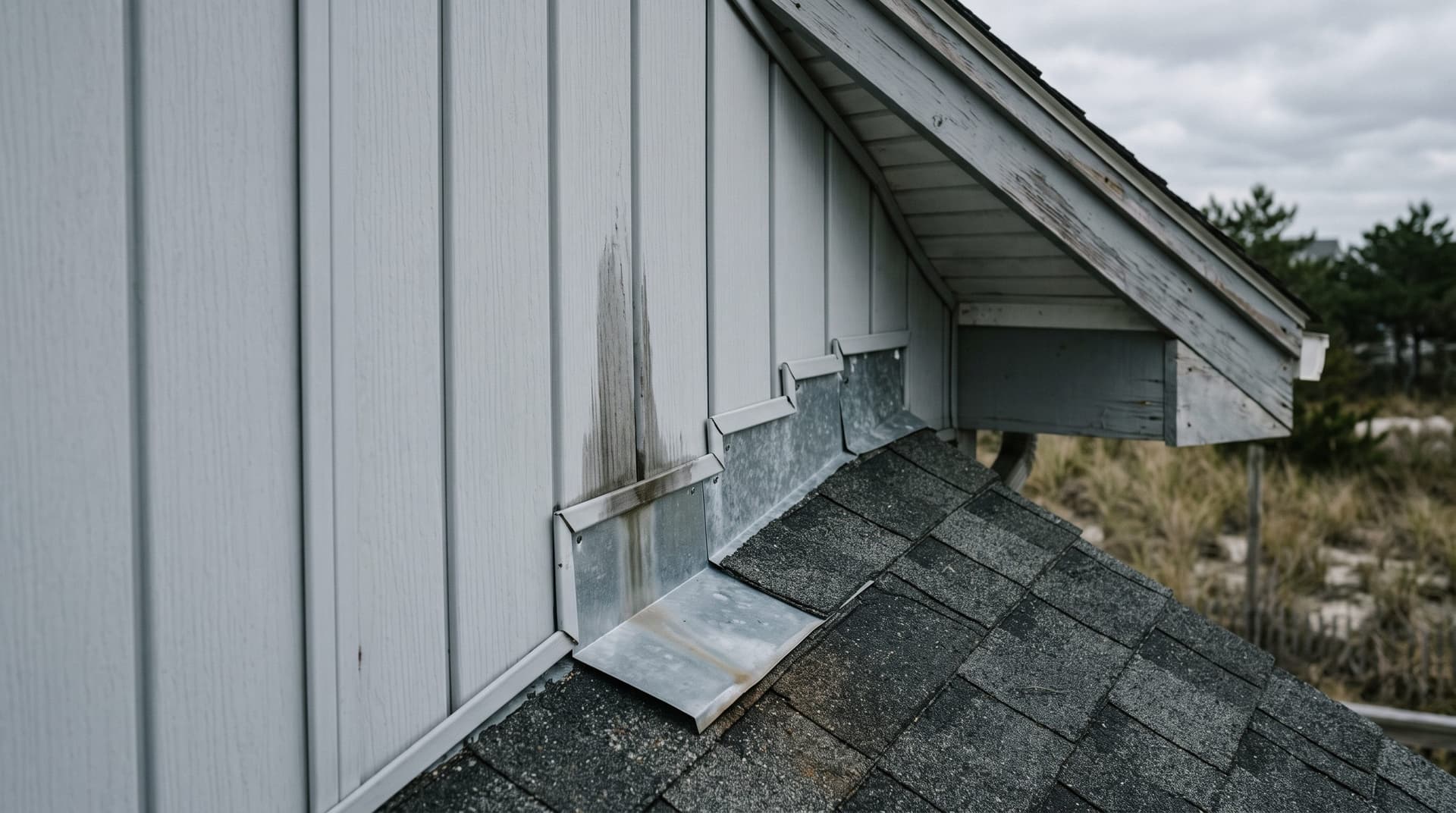
Step flashing is a stack of bent metal pieces, one per shingle course, each lapped over the one below and running up the wall behind the siding. It should be individual pieces. If somebody ran one long strip of aluminum up that joint and caulked it, that is not step flashing, and we see it on maybe a quarter of the repairs we are called to.
Counter flashing or the siding lap is what covers the vertical legs of the step flashing. On a vinyl house the siding and its J channel do that job. The siding has to lap over the flashing, never butt into it and never sit behind it.
Kickout flashing is the small bent piece at the very bottom of the run, where the roof edge meets the wall. Its whole job is to throw water out into the gutter instead of letting it run down behind the siding. It is one piece of metal, it costs almost nothing, and it is the single most commonly missing part on houses built around here in the 1990s and 2000s. When we find rotted sheathing behind siding at the bottom of a roof line, the kickout is missing about 8 times out of 10.
How to tell which one failed before anybody opens it up
You can narrow it down from the ground and from inside.
If the stain inside is high, up near where the roof plane meets the wall, and it shows up during a driving rain more than a steady one, that points at the step flashing or the siding lap above it. Wind is pushing water sideways under a lap that is not deep enough.
If the damage is low, at the bottom of that roof run, and you are seeing it as soft sheathing, blistered paint, or a stain that appears on the inside of the wall below rather than the ceiling, that is the kickout. Go outside and look at where the bottom of the roof edge meets the wall. If you cannot see a small piece of metal turning out toward the gutter, there is not one.
A hose test settles it. Start low and work up, 10 minutes in one spot at a time, with somebody inside watching. Starting at the top tells you nothing because the water passes everything on the way down.
Why you are getting two different answers
Because it genuinely sits between two trades, and most companies only do one of them.
A roofing-only crew can reflash the roof side, but they need siding pulled to do it right, and they are not going to put your siding back. A siding-only crew can pull and reset the siding, but they are not touching your shingles. So each one scopes the half they own, quotes it, and tells you the other half is the other guy's problem. Neither is lying to you. The job just does not divide that way.
We run roofing and siding and nothing else, and this seam is the honest reason that combination matters. When our crew opens one of these up, we do not have to stop at a trade line and schedule a second company. The shingle courses come up, the siding comes off above the run, the flashing goes in as a system, and it all goes back in one visit.
What has to come off to find it
More than people expect, and we would rather say that upfront than discover it with you standing in the driveway.
To do a roof-to-wall flashing correctly, the siding has to come off above the joint, usually a course or two higher than the flashing itself, and the shingles along that run come up. If the kickout is the problem, the bottom two or three courses come off and the corner of the sheathing gets exposed. That is the point where we find out whether this is a flashing repair or a flashing repair plus sheathing.
Wet sheathing is common at the bottom of these runs and it is not automatically a disaster. Plywood that is stained but firm stays. Anything soft enough to take a screwdriver gets cut out and replaced, and if it has been going on for several seasons, the framing underneath gets checked too. On a shore house with cedar impressions or board and batten, expect the siding side to take longer, because matching an older profile is the slow part.
What a correct repair looks like on paper
Ask for these specifics in writing before anyone starts, from us or from anybody else.
- Step flashing as individual pieces, one per shingle course, not a continuous strip and not sealant.
- A kickout flashing at the bottom of the run, explicitly named on the estimate.
- New ice and water shield carried up the wall at the joint, lapped under the flashing.
- Siding lapping over the vertical flashing legs, with the J channel reset, not caulked to it.
- Sheathing replacement priced as a unit rate per sheet so a surprise does not become an argument.
That last line matters more than the rest. A flashing repair where nobody wrote down what decking costs is how a $900 job turns into a number nobody agreed to.
Caulk is not on that list on purpose. Sealant at a roof-to-wall joint is a way to get through a winter, not a repair, and when we see a bead of it smeared across a joint on an inspection it usually means somebody has already been here and treated the symptom.
When it is worth doing more than the repair
If the roof is past about 18 years and the flashing is failing anyway, reflashing it means disturbing shingles that are brittle and near the end. In that case the flashing work is better rolled into the roof itself rather than paid for twice. Same on the siding side: if the wall is already showing rot at the bottom of the run and the siding is original, pulling and resetting a few courses to go back to siding that is failing elsewhere is money spent twice.
We will tell you which of those you are in once we are on the roof, and sometimes the answer is that the repair is the right call and the roof has years left. Not everything is a replacement.
If you are seeing the rot show up in the trim rather than inside, soffit and fascia rot in Ocean County covers that path, and siding repair against replacement on a shore house covers the wall decision. For what else to watch for up top, roof warning signs is the short list. Our roof repair and siding pages cover how we scope both halves, and if you have an active leak, call before the next stretch of rain rather than after it.
Frequently Asked Questions
Is a leak where the siding meets the roof a roofing job or a siding job?
It is a flashing job, and flashing sits in the seam between the two trades. Doing it correctly means pulling siding above the joint and lifting the shingle courses along the run, so a roofing-only crew cannot finish it and a siding-only crew will not touch the shingles. That is why homeowners get two different answers and two half scopes. A company that carries both trades can open it, flash it as a system and close it in one visit.
What is a kickout flashing and why is mine missing?
It is a small bent piece of metal at the very bottom of a roof-to-wall run that throws water out into the gutter instead of letting it run down behind the siding. It costs almost nothing and it is the single most commonly omitted piece on Ocean County houses built in the 1990s and 2000s. When we find rotted sheathing behind siding at the bottom of a roof line, the kickout is missing about 8 times out of 10.
How can I tell whether it is the step flashing or the kickout before anyone opens the wall?
Use the height of the damage. A stain high up where the roof plane meets the wall, worse in driving rain than steady rain, points at the step flashing or the siding lap above it. Damage low down at the bottom of the roof run, showing as soft sheathing or a stain inside the wall below rather than on the ceiling, points at a missing kickout. A hose test confirms it: start low, 10 minutes in one spot at a time, with somebody watching inside. Starting at the top tells you nothing.
How much has to come off to fix it?
Siding above the joint, usually a course or two higher than the flashing, and the shingles along that run. If the kickout is the problem the bottom two or three courses come off and the sheathing corner gets exposed. Wet sheathing at the bottom of these runs is common and not automatically a disaster: plywood that is stained but firm stays, anything soft enough to take a screwdriver gets cut out. Get the decking priced as a unit rate per sheet before the work starts.
Is caulking a roof-to-wall joint a real repair?
No. Sealant at that joint is a way to get through a winter. A bead of caulk smeared across a roof-to-wall seam usually means somebody has already been out and treated the symptom instead of the flashing. The repair is individual step flashing pieces, one per shingle course, with ice and water shield carried up the wall and the siding lapping over the vertical legs.