The Difference Between a Good and Bad Roofing Job
The difference between a good and bad roofing job is almost never the shingle. It is flashing, ventilation and the edges. Here is what to check.
The difference between a good and bad roofing job is almost never the shingle. It is the flashing, the ventilation and the edge details, and all three are buried under the part you can actually see from the driveway. Roughly one in three replacement quotes we write in southern Ocean County goes to a house already on its second roof in under two decades. Those homes were not sold bad shingles. They got a decent shingle laid over a problem nobody bothered to fix.
Updated October 2026.
We get this question in a specific way. Someone has three quotes on the kitchen table, the spread is a few thousand dollars, and they want to know whether the higher number is buying anything real. That is a fair question and most roofers answer it badly, usually by talking about themselves. So here is the work ranked instead of the vendors. If you can name three things to check, you do not have to take anyone's word for it, ours included.
The shingle is the cheapest decision on the roof
Every quote you are holding names a shingle. Timberline HDZ, a competitor's architectural line, something with a weathered-wood color on the sample board. Homeowners spend most of their decision here because it is the only part of the quote written in plain English.
It is also the part that varies least. Architectural shingles from the major manufacturers are more alike than the marketing suggests, and on a shore house the shingle is rarely what fails first. What fails first is the junction where the roof meets something else: a wall, a chimney, a skylight, a valley. Those junctions are labor, not material, and labor is exactly where a low quote gets low.
Where a bad roof actually goes wrong
Flashing. Almost every time.
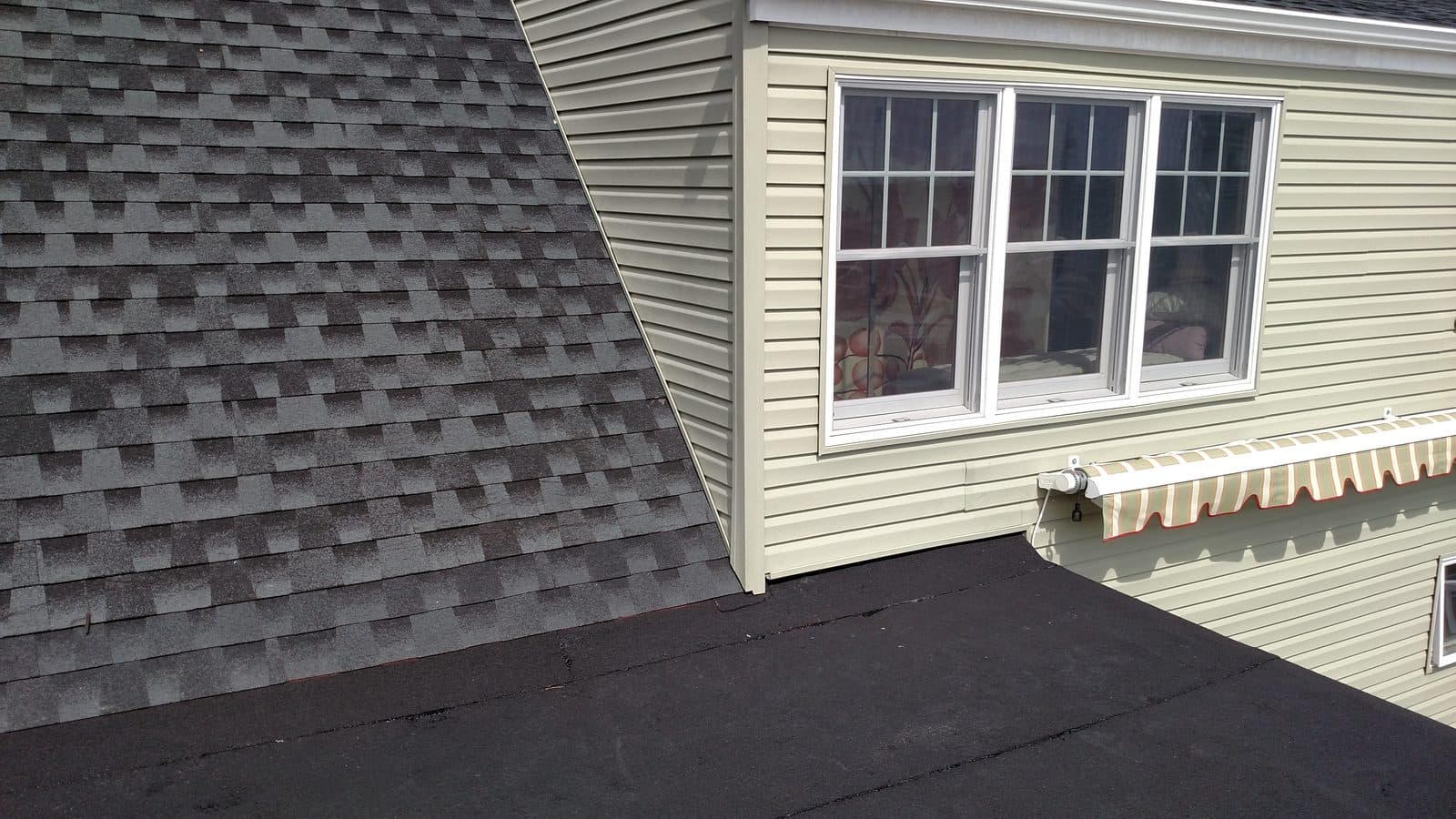
Flashing is the metal that carries water out of the places a shingle cannot cover. Where a roof plane dies into a sidewall, the correct detail is step flashing: one piece of bent metal per shingle course, each one lapped over the one below and tucked behind the siding. It is slow. On a long sidewall it is a lot of pieces.
The cheap version is to leave the old step flashing on the house, run the new shingles up to the wall, and seal the joint with a bead of caulk or roof cement. It looks finished on day one. It looks finished on day four hundred. Then the caulk opens, and because the water is now getting in behind the shingles rather than on top of them, the first thing you notice is a stain on a bedroom ceiling two feet from the wall.
Same story at a chimney, where the job is a step flashing set plus a counter-flashing cut into the mortar joint, and the shortcut is a trowel of tar around the base. If you have ever seen a black smear around a chimney, you have seen someone's second repair of a first shortcut.
Ventilation decides how long it lasts
A roof is a system that has to breathe. Air comes in low at the soffits and leaves high at the ridge, and when that loop works the attic stays close to outside temperature. When it does not, the attic bakes, the shingles cook from underneath, and a 30-year shingle gives you 14 or 15 years.
The common failure is half a system. A ridge vent goes on because it is visible and sells well, the soffit intake stays blocked by old insulation or was never adequate to begin with, and the new ridge vent has nothing to pull. We wrote the long version of this in roof ventilation on older Ocean County ranches, because on the 1960s and 1970s ranch stock around Forked River, Bayville and Lacey it is the single most common reason a roof dies early.
The thing to notice is that ventilation almost never appears as a line item on a quote. Ask whether the intake is being corrected or just inherited.
What you can check yourself
You do not need to get on the roof. A few of these you can do from the ground on day one, and the rest in the week after the crew leaves.
- Look in the dumpster. This is the most useful thirty seconds you will spend. If the old step flashing is not in the debris pile, it is still on your house. Bent, rusty metal in the pile means somebody did the slow version.
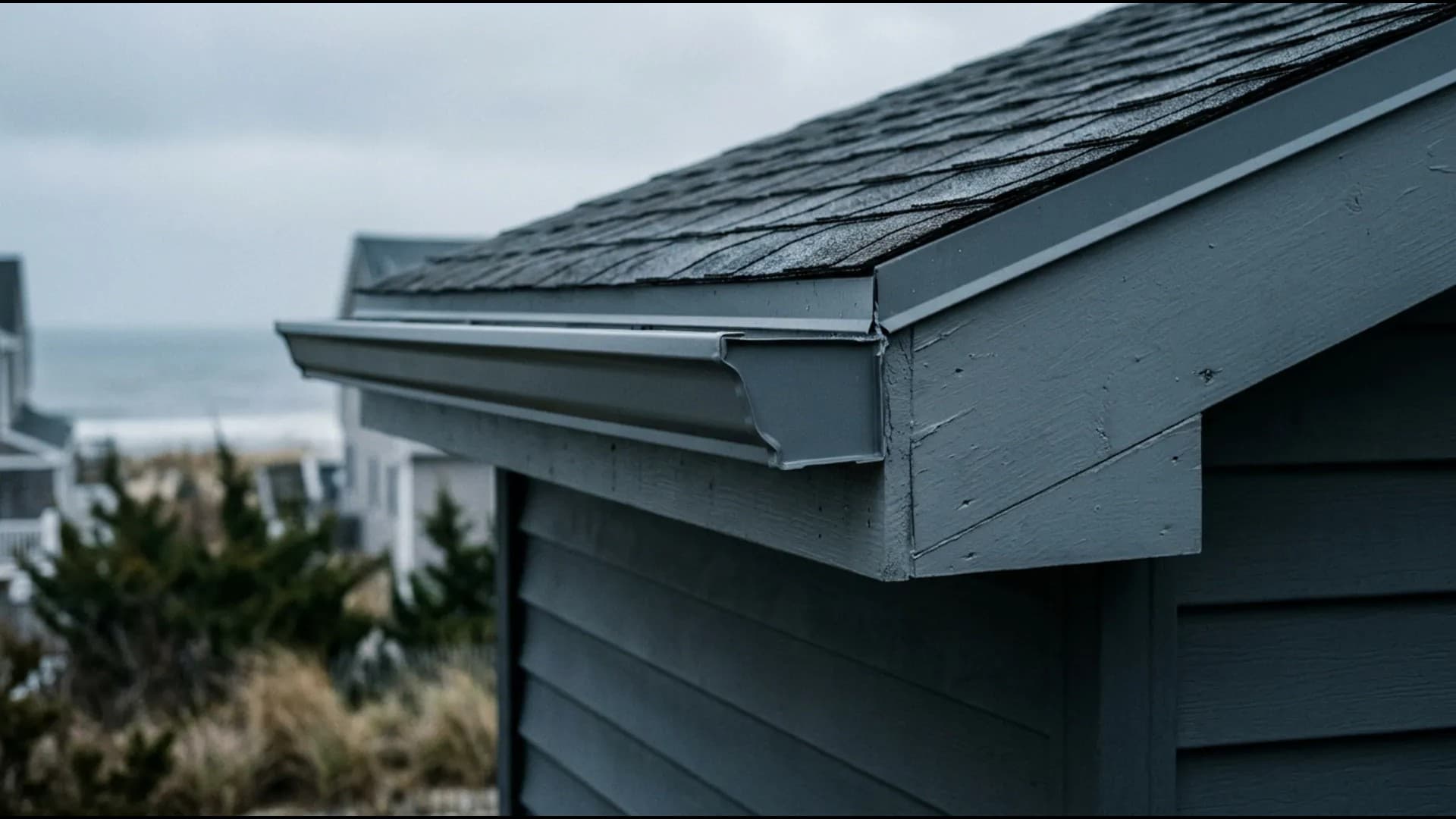
- Check the drip edge. There should be metal along the eaves and up the rakes, under the shingles at the bottom and over them at the sides. No drip edge is a tell, and it is a code item, not a preference.
- Sight the ridge line and the courses. Stand at the corner of the house and look down the ridge, then across a plane. Straight lines and even exposure mean a crew that snapped lines. Wandering courses mean a crew that did not.
- Look at the valleys. A valley should be a clean, consistent channel, either woven or cut to a crisp line. A ragged valley full of sealant is where the next leak starts.
- Go in the attic on a bright day. Daylight at the ridge is normal if there is a ridge vent. Daylight anywhere else is not. Dark streaks on the underside of the decking mean water has been getting in for a while.
- Ask what happened to the soft decking. Any tear-off finds some. A good contractor shows you, replaces it, and the sheets are on the invoice. A bad one shingles over it.
What the better job actually adds
Good is the roof where every junction got new metal, the decking got checked and the ventilation got corrected rather than inherited. That is most of the value and it is not glamorous.
The tier above that is mostly documentation and accountability. We are GAF Certified and NJ HIC licensed (13VH08300200), which matters for one concrete reason: a certified contractor can register the manufacturer's enhanced system warranty, and those warranties require the full system to be installed, not a shingle on its own. We also self-perform roofing, siding, gutters and windows rather than handing the job to whichever crew is free that week, which is why the flashing detail at a roof-to-wall junction is our work and not a subcontractor's.
If the quotes in front of you differ by thousands and nobody has explained why, the line-by-line version is in why one roofing quote comes in thousands lower, and how to hire a roofing contractor in NJ covers the vetting side. When you want someone to walk the roof and tell you which tier you are being sold, that is what our roof replacement estimates are for.
Frequently Asked Questions
Can you tell a good roofing job from the ground?
A lot of it, yes. Sight down the ridge and across each plane for straight, evenly spaced courses. Check that there is drip edge metal at the eaves and rakes. Look at the valleys for a clean channel rather than a smear of sealant. Those three checks catch most rushed work without anyone getting on a ladder.
Does the shingle brand actually matter?
Less than the installation does. Architectural shingles from the major manufacturers perform similarly on a typical Ocean or Monmouth County home, and almost every early failure we are called to started at a flashing detail or an unventilated attic rather than at the shingle itself. Brand matters mainly for the warranty, because an enhanced system warranty has to be registered by a certified contractor and requires the whole system.
How do I know the old flashing was replaced?
Look in the dumpster before it leaves. Old step flashing and chimney flashing come off as bent, weathered metal, and if none of it is in the debris pile then it is still on the house under the new shingles. You can also ask for a photo of the sidewall and chimney before the new shingles went on, which any crew doing the work properly will already have.
Is new ventilation worth paying for during a roof replacement?
It is the cheapest it will ever be, because the roof is already open. Correcting intake at the soffits and exhaust at the ridge while the shingles are off costs a fraction of doing it as its own job later, and on older ranch stock it is often the actual reason the previous roof did not reach its rated life.