How to Hire a Roofing Contractor in NJ Without Getting Burned
The vetting process most Ocean County homeowners skip and regret. License checks, the right questions, the red flags that mean walk away, and how to actually compare two or three quotes side by side.
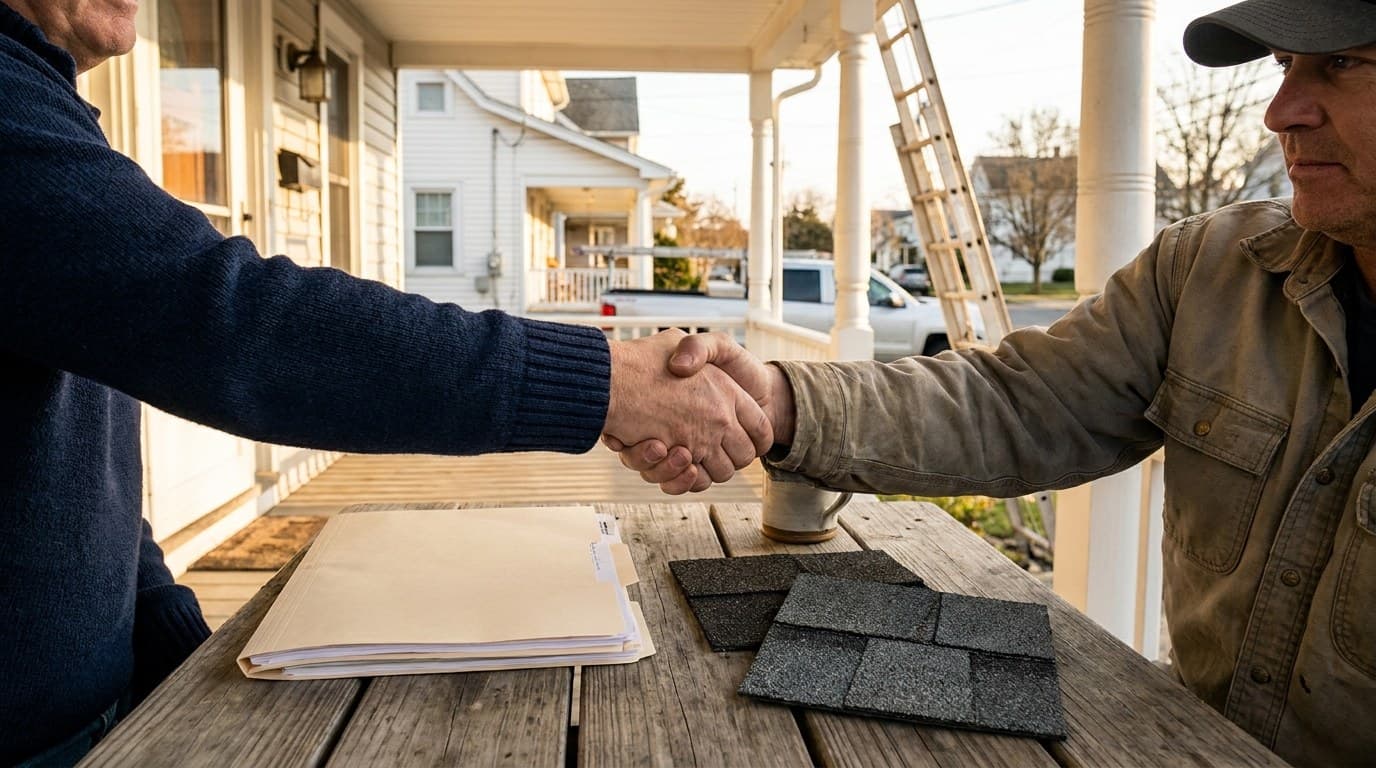
Hiring a roofing contractor is one of the largest checks a homeowner writes on a house they own outright. In Ocean and Monmouth County, that check is going to land somewhere between $9,000 and $25,000 for a typical replacement. Most homeowners spend more time researching a refrigerator. Then they sign a contract with the first guy who left a flyer on the door after a storm and wonder why the roof leaks in February.
This is the version of the conversation we wish every homeowner had before calling us. It works whether you hire Home Pro or a competitor. The point is to not get steamrolled.
How to hire a roofing contractor
The right order matters more than the speed. Most homeowners do it backwards: they get one or two quotes, pick the cheaper one, and sign that week. Then they discover the contractor isn't licensed in New Jersey, isn't actually insured, and the deposit cleared the bank before the truck ever showed up.
The correct order is roughly this. Confirm the roof needs work in the first place — if you're not sure, our roof warning signs guide walks through the early signals. Pull two or three quotes from local contractors. Verify each company's NJ Home Improvement Contractor license and insurance certificates before any of them gets onto your roof for an inspection. Read the actual contract front to back, not just the price line. Compare scope of work line by line, not the bottom number. Then sign.
That sequence weeds out almost every scam and most of the bad workmanship cases we get called in to fix. Skipping any single step is how the trouble starts.
What questions should I ask before hiring a roofer?
Eight questions. Bring them written down. If a contractor gets cagey on any of them, that's information.
- What's your NJ Home Improvement Contractor license number? A real number starts with 13VH. They should rattle it off without checking their phone. Ours is 13VH08300200.
- Can you email me your certificate of insurance and your workers' comp certificate before the inspection? Both, not one or the other. General liability covers your house if a worker drops a hammer through your skylight. Workers' comp covers your liability if a roofer falls off your roof. Without workers' comp, that injury becomes your homeowner's policy's problem.
- Are you GAF Certified, Owens Corning Preferred, or CertainTeed SELECT? Manufacturer certifications mean the company has been factory-trained on the system they're selling and qualifies for the strongest material warranties. We're GAF Certified, which is why we can write 50-year limited warranties on Timberline HDZ.
- Will my project be done by your employees or by subcontractors? Subbed crews aren't automatically a problem, but the answer should be honest. If the bid is from one company and a different company's truck shows up on installation day, that's a flag. Ask whether the subs carry their own insurance.
- Who is on site every day, and what is their phone number? A foreman or owner needs to be reachable during the install. "I'll have someone call you back" is not an acceptable answer when a tarp blows off mid-tear-off.
- Can I see three references for jobs you completed in this town in the last 12 months? Local, recent, specific. Not a list of names with no addresses. Drive past the addresses they give you.
- What's the workmanship warranty and what's it actually written on? A workmanship warranty isn't real until it's in writing on the contract. Ten years is the floor for legitimate roofers in Ocean County. Five is light. Anything under five, walk.
- What happens if you find rotted decking when you tear off the old roof? The honest answer: there's a per-sheet upcharge, billed transparently, and we don't proceed without your sign-off. The wrong answer: we cover anything that comes up, no questions. That bid is hiding the cost somewhere else, and you'll find out where on day two.
The questions matter, but watching how the answers come out matters more. A real roofer with twenty years on Jersey Shore homes will answer all eight without checking notes.
How to verify a roofer's license, insurance, and bonding
Most homeowners take "we're licensed and insured" at face value because checking is annoying. It's also free, takes about five minutes, and catches the people who shouldn't be on your roof.
The NJ HIC license check. Every legitimate home improvement contractor in New Jersey is registered with the NJ Division of Consumer Affairs and assigned a license number that begins with 13VH. The state runs a free public lookup at newjersey.mylicense.com/verification. Search by business name or license number. You should see the contractor name, the registered business address, and an active status. If the search returns nothing or shows a suspended status, stop there.
Certificate of liability insurance. The certificate should name your homeowners' policy or your name as a certificate holder for the duration of the job. Our certificates list general liability of $1 million per occurrence and $2 million aggregate, plus auto liability and umbrella. Read the policy expiration date on the certificate. If it expires in the middle of your scheduled install, that's not a coincidence. Ask for a current one before they're back on your roof.
Workers' compensation. A separate certificate. NJ requires it for any contractor with employees. The carrier name should be a real one — NJM, Hartford, Travelers, Liberty Mutual, etc. If a contractor tells you they don't need workers' comp because their crew is "all subs," that's a problem the IRS would also like to talk to them about, and it leaves you exposed if someone gets hurt.
Bonding. NJ doesn't require home improvement contractors to be bonded the way commercial GCs are. But on jobs over a certain size, bonding through the contractor's surety provides another layer of recourse if the company disappears mid-project. We can provide bond information on request for replacement projects. Most legitimate roofing contractors can do the same.
The verification step is also where you check Better Business Bureau standing, Google reviews count and consistency (200 reviews averaging 4.9 is real signal; 12 reviews all 5-star posted in the same week is a warning), and any active lawsuits in NJ Superior Court (free public records search). Five minutes of homework saves a five-figure mistake.
Red flags when hiring a roofing contractor
The patterns we see when we get called to fix someone else's bad roof:
- Door-to-door after a storm. Storm chasers run a route from one weather event to the next. They sign as many contracts as they can in a week, take deposits, subcontract the work to whoever they can find, and leave town. If a contractor knocks on your door uninvited within a week of a nor'easter or hurricane, the answer is no. Real local roofers are too busy to canvass neighborhoods. We break the whole con down in how to spot a storm chaser after a Shore storm, including the one NJ license question that ends the conversation.
- Pressure to sign today. Real quotes are good for 30 days. Anyone telling you the price is only good if you sign before they leave the kitchen is either trying to lock you out of comparison shopping or hiding something in the contract.
- Cash-only or large up-front deposit. NJ caps contractor deposits at one-third of the project cost or $1,000, whichever is less, on most home improvement contracts. Anyone asking for 50% up front is either ignoring the law or planning to disappear with it. Pay by check, not cash, and keep records.
- No physical address on the truck or business card. A PO Box is not an address. A real local roofer has a yard, a shop, or at minimum a registered home address you can verify on the NJ HIC lookup.
- "We don't pull permits." Most roof replacements in Ocean and Monmouth County require a permit pulled with the local township. The permit process triggers a final inspection that confirms the work meets code. A contractor avoiding permits is hiding work from the township inspector. Six years from now when you sell the house, the unpermitted work shows up in the home inspection and becomes your problem.
- Quote on the back of an envelope. Or a single line on a yellow notepad: "Roof Replacement: $9,500." A real quote runs three to seven pages — scope of work, materials by manufacturer and product line, warranties, payment schedule, dates, signatures. If it's not itemized, you can't compare it.
- The bid is way under everyone else. If three legit local roofers are within 10% of each other and a fourth is 30% lower, the fourth is leaving something out. Open the quote and find what's missing. Usually it's the underlayment, the ice and water shield, the disposal fee, or the workmanship warranty.
- Pushy on insurance claims. A roofer who walks your property and then immediately tells you to file a storm claim, before you've even confirmed damage, is fishing. Real storm claim work starts with documentation, not a sales pitch. We wrote the storm claim playbook for exactly this reason — know what real damage looks like before anyone files anything in your name.
How to choose between different roofers
You did the work. You have two or three quotes from licensed, insured, locally referenced contractors. The numbers are within 10% of each other. Now what.
The price line is the wrong place to start. Lay the three quotes side by side and compare the scope of work line by line. Specifically:
- Underlayment product. All three should specify a product. "Synthetic underlayment" is the floor. Brand and product name (GAF Tiger Paw, Owens Corning ProArmor, etc.) is the standard. "Felt paper" or unspecified is the ceiling on what that quote is worth.
- Ice and water shield. Should appear as a line item with linear footage at all eaves, valleys, and penetrations. If a quote says "where required," that's negotiable later, which means more later.
- Shingle product. All three quotes should name the same shingle line, or close. If one is GAF Timberline HDZ and another is "30-year architectural shingle," those aren't the same thing. Look up the product warranty terms and the actual MSRP per square.
- Flashing. "All new flashing" is the right answer. "Reuse existing flashing" on a 20-year-old roof is the wrong one.
- Decking allowance. Quotes should specify a per-sheet replacement cost for rotted plywood found during tear-off, and a clear process for sign-off before extra work proceeds.
- Workmanship warranty. Length and what it actually covers. A 10-year workmanship warranty that only covers leaks at penetrations is weaker than a 5-year warranty that covers every aspect of the install.
- Cleanup and disposal. Magnetic sweep, dumpster fee, debris disposal. Should all be in the price.
- Permit responsibility. The contractor should pull the permit and handle the township inspection. If the quote shifts that to you, the price isn't apples-to-apples.
Once the scopes are matched up, the price difference shrinks fast. The quote that was 15% cheaper now ties or comes in higher because they were leaving out underlayment and disposal. That's normal. That's why you compare scope, not totals.
If after all that two quotes are genuinely the same scope at the same price, the tiebreakers are workmanship warranty length, manufacturer certification, and the local reference quality. We'd take a roofer with 200 verifiable Google reviews from Lacey, Forked River, and Manahawkin over a roofer who's bigger but mostly works in North Jersey. Local matters because the failure mode of a Jersey Shore roof is specific to coastal weather, and a contractor who only does ten roofs a year on the coast hasn't seen what salt air does to flashing fasteners over a decade.
The shorter version
Verify the license. Demand both insurance certs. Ask the eight questions and listen to the answers. Walk away from anyone door-to-door, anyone pushing same-day signatures, anyone asking for more than 1/3 down. Compare scopes line by line, not totals. Pick local over big.
If you're in Ocean or Monmouth County and you want a contractor who'll stand for every one of those checks, we'll come out, walk the roof, photograph the problems, and send you a written quote within 48 hours. We'll also tell you if your roof doesn't need replacing yet — that conversation has cost us bids and saved homeowners money. Request a free inspection or call Stephen directly at (732) 703-7808. And before you assume the contractor's permit pitch is a real cost line, read our breakdown of the 2018 ordinary maintenance rule: do you actually need a roof permit in NJ.