Is Your Jersey Shore Roof Ready for Hurricane Season? A Pre-Summer Storm Checklist
Atlantic hurricane season starts June 1, and the Jersey Shore takes the brunt of every storm that tracks up the coast. The time to find out your roof is not ready is not when the wind is already at 70 mph. Here is exactly what to check on an Ocean or Monmouth County roof before the first named storm, and what makes a roof actually hold in a coastal blow.
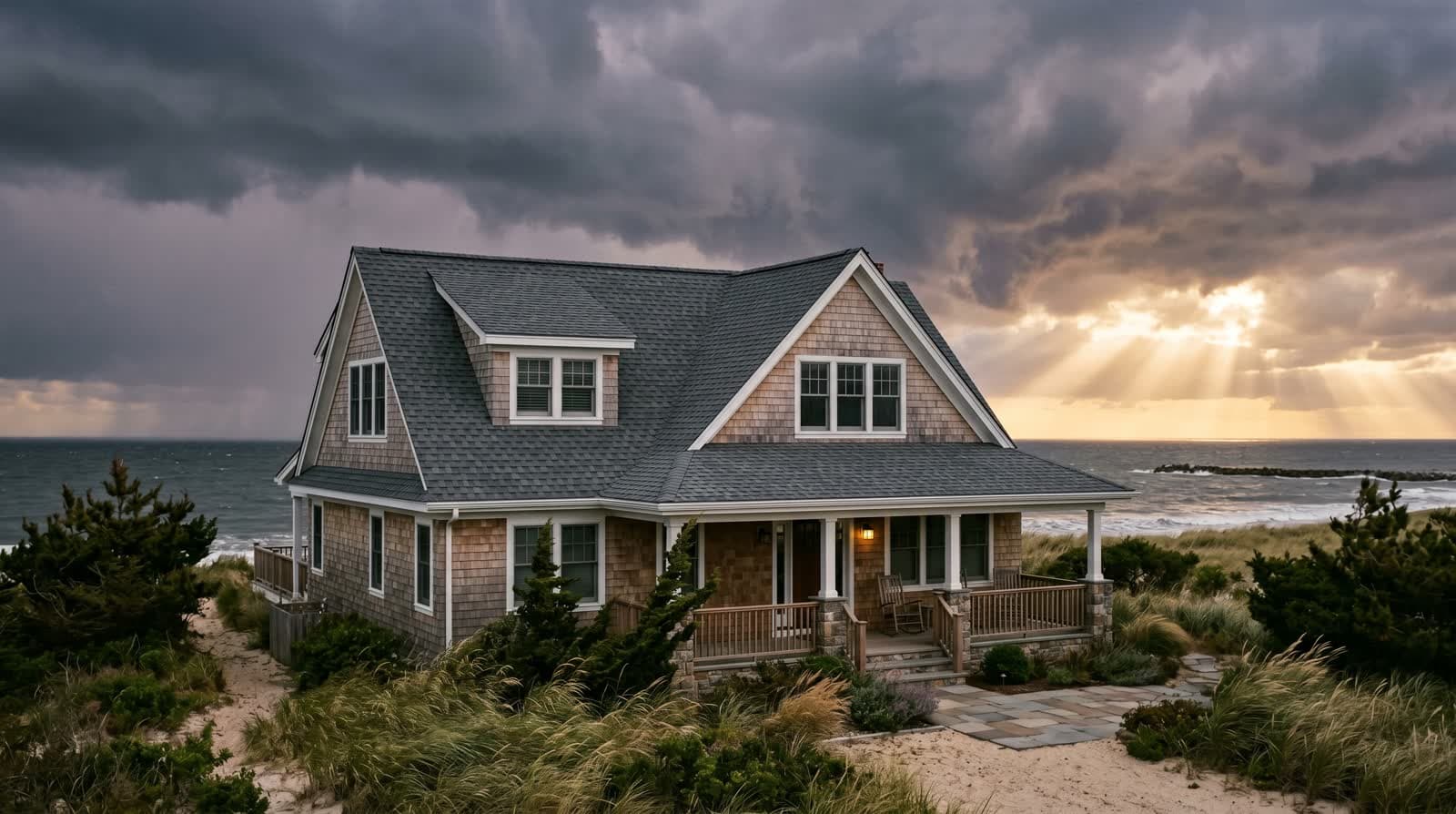
Atlantic hurricane season runs June 1 through November 30, and if you live in Ocean or Monmouth County you do not need a meteorologist to tell you the Jersey Shore is in the path. We do not have to take a direct hit to get hurt. A storm tracking 200 miles offshore still throws 50 to 70 mph gusts and days of driving rain at the coast, and that is exactly the kind of weather that finds every weak spot on a roof. Sandy was the once-in-a-generation event everyone remembers, but it is the routine coastal blows, the nor'easters and the brush-by tropical systems, that do most of the cumulative roof damage on shore homes.
The worst time to learn your roof is not ready is when the wind is already howling and the water is already in the bedroom ceiling. The right time is now, in the last clear weeks of spring before the first named storm. This is the checklist we run on homes from Forked River and Lacey down through Barnegat, Manahawkin, and the LBI corridor, and up through Toms River, Brick, and the Monmouth shoulder towns. Some of it you can check yourself from the ground. Some of it needs a roofer on the roof. All of it is cheaper to handle in May than to repair in September.
Why Coastal Roofs Take More Punishment Than Inland Roofs
A roof in Forked River lives a harder life than the same roof 40 miles inland, and it is worth understanding why before you inspect one.
Wind uplift. Coastal homes catch higher sustained winds and stronger gusts with nothing to break them. Wind does not push a roof down. It lifts shingles up at the edges and peels them back. Once one shingle lifts, the wind gets under the next one, and a failure spreads fast.
Wind-driven rain. A coastal storm does not drop rain straight down. It drives it sideways at 60 mph, forcing water up under shingles, behind fascia, and through any gap that a gentle rain would never reach.
Salt air. The same salt that rusts everything else on a shore property corrodes roofing nails, flashing, drip edge, and fasteners. A roof that looks fine can have fasteners that have lost their grip.
Older housing stock. A lot of Ocean County's ranches and capes were built decades ago, before current wind-rated installation standards. Many were re-roofed by whoever was cheapest. Those roofs were never built for the wind loads we now plan for.
Put those together and the message is simple: a Jersey Shore roof needs to be in better shape than an inland roof just to survive the same storm, and most of them are not.
What You Can Check From the Ground Right Now
You do not need to get on the roof to catch the obvious problems. Walk the perimeter of the house with a pair of binoculars on a clear day and look for these.
- Lifted, curled, or missing shingles. Any shingle that is already curling at the edges or sitting up off the one below it is a wind catch. In a storm it is the first thing to go, and it takes its neighbors with it.
- Shingle debris in the gutters or yard. Granules washing into the gutters and shingle pieces in the flower beds after a normal rain mean the roof is already shedding. A storm will accelerate it.
- Sagging or pulled-away gutters. Gutters that are sagging, pulling off the fascia, or overflowing cannot move storm volume. We get into gutter capacity below, but from the ground you can at least see what is failing.
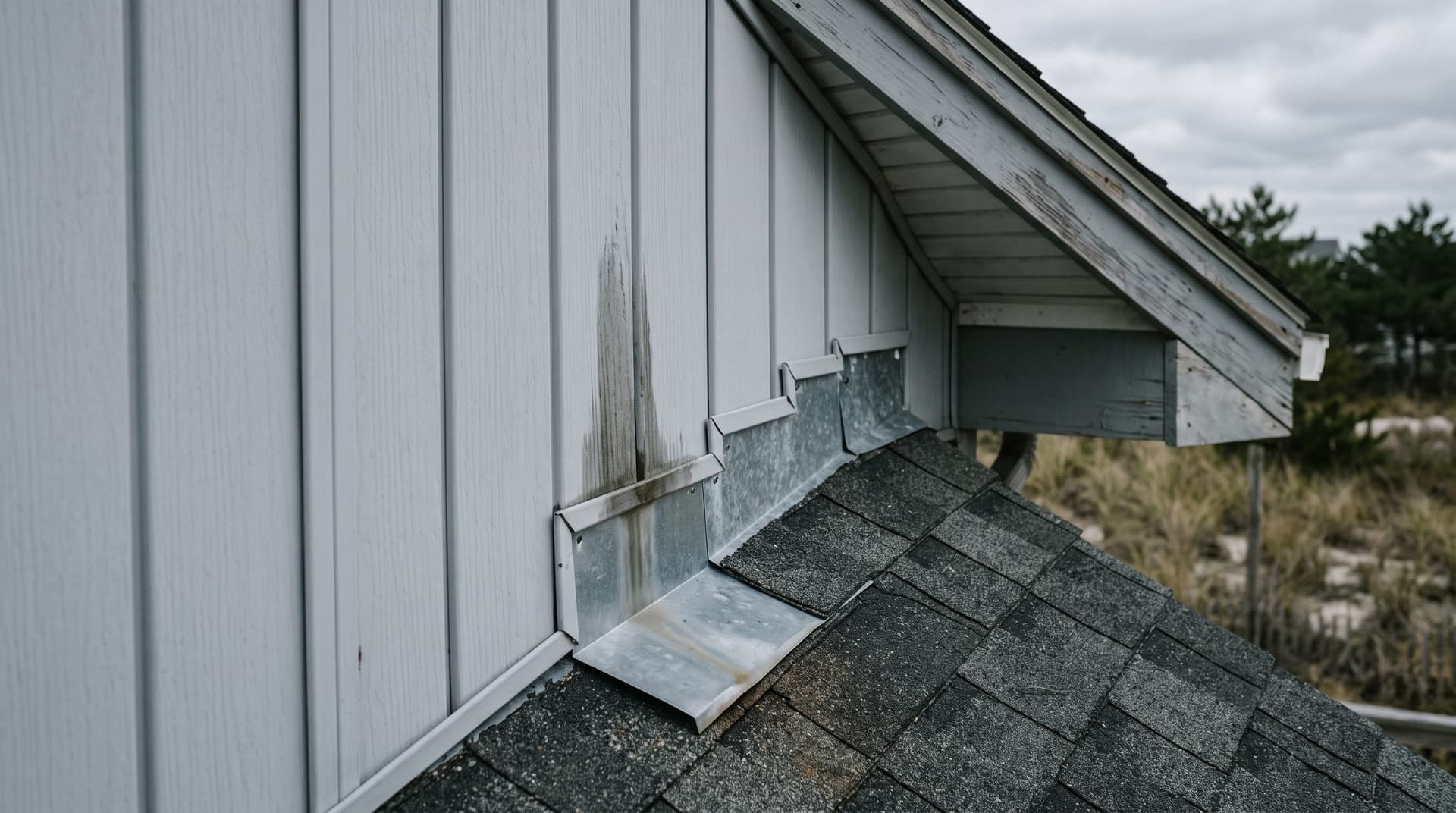
- Daylight or staining at the soffits and fascia. Peeling paint, soft wood, or visible gaps at the roof edge are where wind-driven rain gets in.
- Interior ceiling stains. Walk the top-floor ceilings and closets. A brown ring you have been ignoring is an active leak that a storm will turn into a real problem. If you are seeing these signs, our guide to the five roof warning signs you should not ignore covers what each one actually means.
What Makes a Roof Actually Hold in a Coastal Storm
This is the part most homeowners never see and most cut-rate roofers skip, and it is the difference between a roof that survives a blow and one that peels. When we install a GAF system on a shore home, the wind resistance comes from the layers underneath and the edges, not just the shingle you can see.
- Drip edge, properly installed. A metal drip edge at the eaves and rakes is what keeps wind from getting under the first course of shingles and is the starting point for the whole edge system. It is code, it is cheap, and it is routinely missing or installed wrong on older shore roofs. Without it, the wind has a handle to grab.
- Ice and water shield where it counts. A self-adhering ice and water membrane along the eaves, in the valleys, and around every penetration seals around nail shanks and stops wind-driven water that gets past the shingles from reaching the deck. On a coastal home, valleys and eaves are exactly where the sideways rain attacks.
- Synthetic underlayment, not felt. Synthetic underlayment over the rest of the deck is the secondary water barrier and it does not tear in the wind the way old felt paper does. If your shingles ever do lift in a storm, the underlayment is what stands between the wind-driven rain and your plywood.
- The right shingle, nailed right. GAF Timberline HDZ architectural shingles carry a high wind rating when installed to spec, with the nails driven in the reinforced nailing zone and the correct number of nails per shingle. A premium shingle nailed wrong fails at half its rated wind speed. The install matters as much as the product.
- A sealed, vented ridge. A properly installed ridge cap and ridge vent finish the system. A loose or poorly nailed ridge is a common storm failure point. Ventilation also keeps the deck healthy year-round, which we cover in our piece on roof ventilation on older Ocean County ranches.
If your roof was installed cheap or installed decades ago, there is a real chance one or more of these is missing. You cannot see it from the ground, which is why a pre-season inspection by a roofer who will actually tell you the truth is worth the call.
Do Not Forget the Gutters and Drainage
Hurricane season on the shore is as much a water event as a wind event, and the gutters are the part of the system that handles volume. A tropical system can drop several inches of rain in a few hours, and Ocean County's flat coastal lots do not shed it fast.
- Clear them before June. A gutter packed with last fall's leaves and this spring's seed pods overflows in a heavy rain, dumping water against the fascia and the foundation instead of carrying it away.
- Check the capacity. Standard 5-inch gutters are undersized for the rain volume a coastal storm throws at a larger roof. We covered why and when to step up in our breakdown of sectional versus one-piece gutters. If your gutters overflow in a normal hard rain, they will be useless in a storm.
- Aim the downspouts away from the house. Extensions that carry water several feet off the foundation matter more on flat shore lots than anywhere else. The roof can be perfect and you still get water in the basement if the downspouts dump at the foundation.
Secure Everything That Can Become a Projectile
One piece of storm prep has nothing to do with the roof structure and everything to do with what hits it. A lot of shore-home roof damage in a storm is not the wind directly, it is debris. A loose section of fascia, a satellite dish, a poorly attached vent, or the neighbor's patio furniture becomes a missile at 60 mph. Before the season, walk the property and secure or store anything that can fly, and have a roofer check that vents, flashing, and roof-mounted hardware are fastened down. A single airborne branch through a roof plane turns a storm you would have ridden out into an insurance claim.
If a Storm Does Hit: Document Before You Touch Anything
Prep is most of the battle, but know the move if a storm does damage the roof. Get photos of everything before any cleanup or temporary repair, ideally from the ground and from any safe vantage, and keep records of the storm date. Do not let a storm-chaser who shows up at the door the next morning climb on your roof or sign you to anything. Coastal towns fill with out-of-state crews after every named storm, and most of them are gone by winter. We walked through how to handle the insurance side without getting played in our guide to filing a roof storm damage insurance claim in NJ. The short version: document first, call a local roofer who will still be here next year, and let them deal with the adjuster. One more move before the season: read whether your roof settles at replacement cost or actual cash value, because on an aging ACV roof a covered claim can still pay near zero. We cover that in will insurance cover your roof? age, ACV vs. RCV.
Get a Pre-Season Inspection From a Local Roofer Who Will Be Here in November
The single best thing you can do before June is have a real roofer walk your roof and tell you straight whether it is ready. Not a free-inspection sales pitch designed to sell you a roof you do not need, and not a storm-chaser. A local, GAF-certified roofer who lives and works in Ocean and Monmouth County and will still be answering the phone after the season ends. We will tell you if your roof is fine for another few years, if it needs targeted repairs to be storm-ready, or if it is genuinely at the end of its life and gambling on it through hurricane season is the wrong bet. If a full replacement is on the table, we lay out exactly what a new roof involves with no "starting at" games.
Home Pro Remodeling has been installing and repairing roofs across Ocean and Monmouth County for over 20 years. We are GAF certified, we are local, and we are the crew that is still here when the next nor'easter rolls through in February. If you want your roof checked before the first named storm of the season, reach out for a pre-season inspection and we will give you the honest read on whether it is ready.