Are Gutter Guards Worth It on a Jersey Shore House?
Are gutter guards worth it at the Jersey Shore? Real NJ installed costs, which types beat pine needles, and the coastal ice failure to skip.
Are gutter guards worth it on a Jersey Shore house? Sometimes, and the honest range matters more than the yes. Good micro-mesh guards run about $8 to $18 a foot installed here, so figure $1,200 to $2,400 on a typical single-story ranch. I am Stephen Flury, and I have run Home Pro Remodeling on the Ocean and Monmouth County shore for more than 20 years. I will talk you out of guards as fast as I will sell them. Under tall oaks or white pines they pay for themselves in a couple of years of skipped cleanings. Over a clean roof with no trees near it, they are a gutter-cleaning bill you paid up front.
Updated September 2026 with current installed price ranges, a type-by-type ranking, and the coastal ice failure I keep seeing on low-pitch bayfront roofs.
What gutter guards actually change, and what they don't
Start with the job a guard actually does. A guard keeps leaves, twigs, and roof grit out of the trough so water still reaches the downspout. That is the whole promise. It does not stop water from overshooting a gutter in a hard rain, it does not fix a gutter pitched wrong, and it does not save a rotted fascia board. On the shore I watch people buy guards to solve an overflow that was never a debris problem, and the guard makes it worse by adding one more surface for water to skate over. A guard earns its money only when your gutters clog, you clean them more than twice a year, and the roof edge underneath is sound. If the trough is undersized or hung flat, spend there first, not on a lid.
The debris that beats each type of guard
Every guard is a filter, and the debris on your roof decides which filter wins. Broad oak and maple leaves sit on top of almost anything and blow off, so a basic screen handles them. Pine needles are the killer. They are thin and stiff, and they weave straight through screens and drop into the trough, which is why homeowners ask whether gutter guards work with pine needles at all. The answer is that only fine micro-mesh does. Then there is the debris nobody plans for on an asphalt roof, shingle grit. As a roof ages it sheds granules by the cupful, and that sand-fine grit blinds a mesh over a few seasons the same way it clogs a bare gutter. Salt spray adds a sticky film on bayfront homes in Bayville and Barnegat that cakes grit and pollen onto the mesh. Match the guard to your worst debris, not the brochure photo.
Gutter guard types compared, ranked honestly
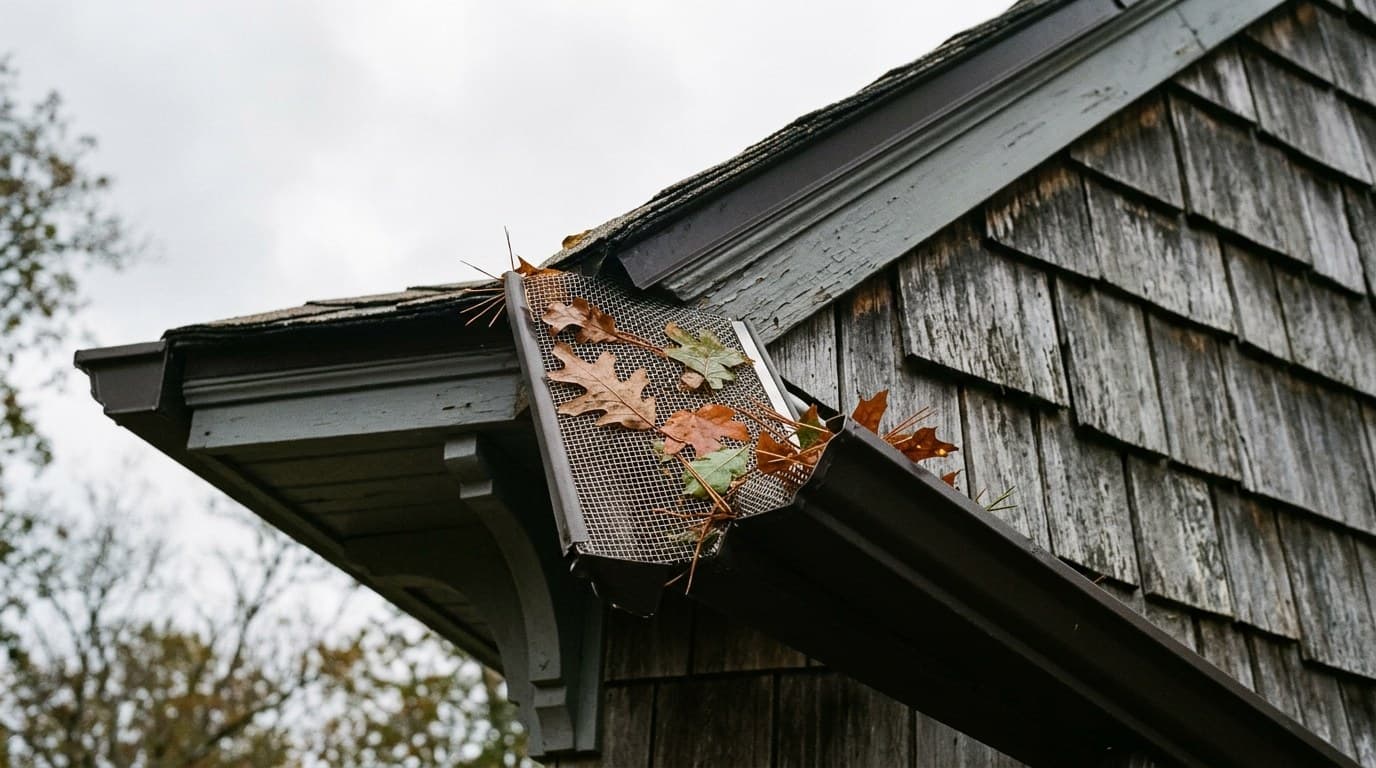
Here is how the four common types compare on a shore roof, best to worst for most homes. Stainless micro-mesh on a solid aluminum frame is the one I install and the one worth paying for; the fine mesh stops pine needles and most grit, and a rigid frame will not sag. A reverse-curve or surface-tension guard, the kind that wraps over the nose of the gutter, sheds leaves well but throws water in a downpour and, as I will get to, turns dangerous with ice here. Foam inserts are cheap and you can drop them in yourself, but they soak up grit and organic muck, grow weeds, and rot inside two or three years in our humidity. Brush guards, the pipe-cleaner kind, are the worst of the bunch; needles and seed pods lodge in the bristles and you end up cleaning a guard instead of a gutter. If a sales rep leads with foam or brush, that is a price play. For the trough-and-downspout side of the bill, here is what gutter installation costs in NJ.
Coastal wind and the clip-on trap
Wind off the bay changes the math on anything that clips or snaps on. A lot of budget guards hold with plastic clips or friction alone, and a 50-mile-an-hour gust off Barnegat Bay peels them up like a playing card. Once one edge lifts, it funnels water behind the gutter and straight down the fascia, which is the exact damage the guard was sold to prevent. The failure I remember most was on a low-pitch bayfront roof in Bayville: a reverse-curve guard where wind-driven rain rode up under the curve during a nor'easter, filled the trough from the wrong side, and left the homeowner with a soaked soffit. Anything I put on a shore roof screws into the roof deck or the gutter itself, never clips, and I keep surface-tension guards off low pitches entirely. Ask any installer how the guard attaches before you ask what it costs.
Ice, overflow, and the winter failure
Winter is where guards get oversold and undertested, so let me be blunt about gutter guards and ice. A guard does nothing to stop an ice dam. Ice dams come from heat leaking into the attic and melting snow that refreezes at the cold eave, and that happens with or without a lid on the gutter. Worse, some guards make the ice trouble. On that same class of low-pitch roof, meltwater follows a reverse-curve nose, refreezes on the front lip in a hard freeze, and builds a ledge of ice that can pry the guard off the shingles. Micro-mesh behaves better because water drops straight through, but a sheet of ice over any mesh still blocks flow until it melts, so no guard is a winter cure. If you get ice dams, the fix is attic air-sealing and insulation. Check your roof ventilation too, because a hot deck is half of every ice dam I see.
When guards pay for themselves, and when they don't
Run the money before you decide. A pro gutter cleaning on a shore home runs about $150 to $300 depending on height and roof size, and a heavily treed house needs it twice a year, so call it $300 to $600 a year. Good micro-mesh at $8 to $18 a foot, roughly $1,200 to $2,400 installed on that same house, pays back in four to six years, and sooner once you count the ladder fall you did not take. That is real gutter guard cost math for NJ, and it only works when trees drive the bill. On a clean roof in a newer development with no big trees, you might clean the gutters once every couple of years for a hundred bucks, and the guard never earns back. Guards are a debris solution. If you do not have a debris problem, you are pre-paying for one you will never have.
What to check before you spend on guards at all
Before you spend a dollar on guards, check the gutter under them. Are the troughs pitched so water runs to the downspouts, or do they hold standing water a day after rain? Are they hung tight to a solid fascia, or pulling away? Are you on 5-inch gutters when your roof area really needs 6-inch and an extra downspout? A guard on an undersized or sagging gutter hides the real problem and makes the eventual repair messier. If your gutters leak at every joint instead, that is a sectional versus one-piece gutters question, and no lid fixes it. Fix pitch, hangers, and sizing first, and honestly a lot of Lacey, Waretown, and Toms River homes I look at need that more than they need a guard. If you want the trough handled right, that is our gutter work, and if you are still deciding who should touch your roof edge, here is who should hang your gutters. Whatever you pick, buy the guard for the trees on your roof, not the pitch from a door-knocker.