Vinyl Siding vs Fiber Cement on Ocean County Homes: What Actually Holds Up to Salt Air, Wind, and Twenty Jersey Shore Winters
The siding decision on a Jersey Shore home is bigger than the roof in some ways: more surface area, more weather exposure, and a twenty to fifty year commitment. Most homeowners get pitched the same vinyl product and never hear an honest comparison to fiber cement. Here is what each one really costs, how each one fails on the coast, and which one belongs on a Forked River, Bayville, Manahawkin, or Toms River home.
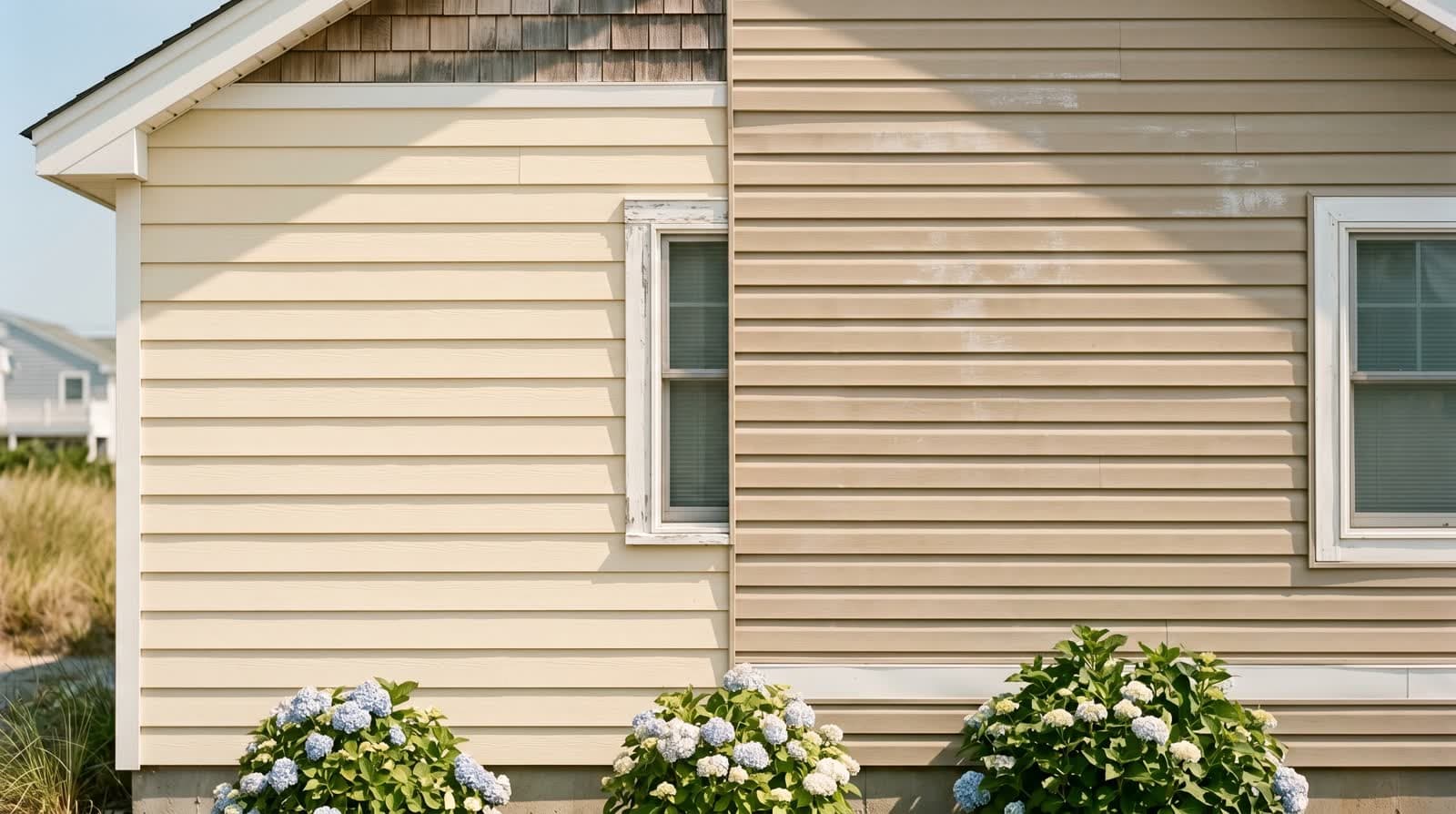
The siding on a Jersey Shore house gets hit harder than almost any other surface on the property. More square footage than the roof on most homes. Direct sun for most of the day on the south and west elevations. Salt-laden air year-round within five miles of the ocean. Wind-driven rain in every nor'easter. Hurricane-force gusts every few years. Freeze-thaw cycles all winter that work into every seam, joint, and fastener. The siding choice that holds up to all of that on a Forked River, Lacey, Bayville, Barnegat, Manahawkin, Toms River, or Brick home is a different conversation than the same choice on a house in central Jersey.
Homeowners around here mostly get pitched the same vinyl product, mostly because vinyl is what most local contractors sell most of, and mostly because it is cheap to install and easy to spec. Vinyl is fine on a lot of houses. It is the wrong call on others. Fiber cement is the alternative almost nobody at the shore explains honestly, and on the right house it pays for itself two or three times over in a thirty-year window. Here is the comparison every Ocean County homeowner should hear before signing a siding contract.
What Coastal Ocean County Does to Siding
Five forces work on siding at the shore, and they stack differently than they do inland.
- Salt air. Every house within about five miles of the ocean carries salt residue on every exterior surface year-round. Salt corrodes metal fasteners, breaks down lower-grade paint, eats unsealed wood, and accelerates surface chalking on vinyl.
- UV exposure. South and west elevations take direct sun most of the day from May through September. Lower-grade vinyl fades visibly inside a decade. Painted surfaces need a real exterior paint with UV inhibitors, or they bleach.
- Wind load. Hurricane and nor'easter wind events drive sideways rain into every seam and put real uplift force on every panel. The fastening pattern that holds in a Pennsylvania home does not hold here. Loose vinyl panels in a storm are a routine call.
- Freeze-thaw. Coastal Ocean County stays just cold enough in January and February that water trapped behind siding panels freezes and expands. Anything porous, unsealed, or improperly flashed lets water in and starts failing from behind.
- Salt-driven mildew and algae. Warm, humid summers plus salt-laden surfaces are perfect for the same black streaking we see on shore roofs. Most siding surfaces show it within five years, north elevations worst.
An Ocean County siding spec has to handle all five. Inland siding sometimes only has to handle one or two seriously.
Vinyl Siding: Where It Wins and Where It Loses
Vinyl siding is a hollow PVC panel that locks horizontally onto the wall sheathing through a nailing flange. It is the most-installed exterior on the Jersey Shore by a wide margin, and there are good reasons for that.
What vinyl does well
Price. Vinyl runs roughly $4 to $9 per square foot installed in Ocean County, all-in, including wrap, trim, and J-channel. A 2,000-square-foot home reside in vinyl is often a $12,000 to $20,000 project. That is cheap money for full exterior coverage.
Install speed. A two-man crew can side a typical Ocean County ranch in four to six working days. Less labor exposure means less weather risk during the install.
No painting, ever. Vinyl is through-color. You will never paint it. For a homeowner who does not want exterior maintenance on the calendar, that is a real win.
Decent insulation when foam-backed. Foam-backed vinyl adds an R-value layer to the wall envelope. Not a huge number, but a real one, and it stiffens the panel against wind uplift.
It will not rot. Vinyl is PVC. It cannot rot. Behind it, the OSB sheathing can rot if water gets in, but the panel itself is immune.
Where vinyl fails on the coast
Fade. Lower-grade vinyl fades hard on south and west elevations. Tan, beige, and gray hold reasonably well. Anything in the deeper saturated colors, dark blues, hunter greens, deep reds, will fade within seven to ten years and the fade pattern follows the sun. The line between original color and faded color across an elevation is one of the easiest ways to spot a 12-year-old vinyl reside from the curb.
Wind uplift. Vinyl is fastened in a way that lets it expand and contract with temperature. That same fastening pattern means panels can pop loose in a strong storm. We have done a lot of repair calls after every named storm in Ocean County to reset blown-loose panels.
Impact damage. Vinyl is brittle in cold weather. A baseball, a windblown branch, or a snowblower discharge will crack a panel. The crack does not refuse to come back, you replace the panel, and matching the original color on a faded wall is often impossible.
Chalking. The salt-air surface oxidation that produces visible chalk on vinyl panels accelerates near the coast. You can wash it off, but the panel never looks new again.
Cheap looks cheap. Builder-grade vinyl in 2026 is what builder-grade vinyl in 1996 was. It looks like vinyl. On a $400,000 to $800,000 home, the curb appeal cost of the wrong vinyl spec is real.
What we recommend in vinyl
If vinyl is the right call for the budget and the house, we will not install bottom-grade product. We use insulated, foam-backed vinyl in the .046 to .055 inch thickness range, from a manufacturer with a real warranty against fade. We will not install the $2-per-square-foot builder-grade panels. They will fail visibly in this climate.
Fiber Cement Siding: Where It Wins and Where It Loses
Fiber cement is a portland cement, sand, and cellulose fiber composite, pressed into plank or panel form, factory-primed and pre-painted. The dominant brand in Ocean County is James Hardie, with Allura and Nichiha as alternatives. It is a completely different product than vinyl and a completely different conversation.
What fiber cement does well on the coast
Wind rating. James Hardie HardiePlank with their HardieZone HZ5 product for our climate is rated to 150 mph wind speeds when installed correctly. That is a serious rating in hurricane country.
Salt and UV resistance. The factory-applied ColorPlus finish carries a 15-year color warranty on the coast and tends to hold longer than that in real-world performance. The cement substrate does not chalk, fade, or oxidize.
Impact resistance. Fiber cement is dense and tough. Baseballs, branches, and snowblower discharge bounce off. The product is not invincible but it is dramatically more impact-resistant than vinyl.
Fire rating. Class A fire rating. This matters less in residential Ocean County than in wildfire country, but it is one less category to worry about, especially for homes near wooded lots.
No rot, ever. Like vinyl, fiber cement cannot rot. Unlike vinyl, it also will not warp, melt, or soften in direct sun against a glass reflection from a neighbor.
It looks like real siding. Up close and from the curb, HardiePlank looks like painted wood. The board profile, the shadow line, and the texture carry the curb appeal of a much higher-end house than the same elevation in vinyl.
Where fiber cement loses
Price. Fiber cement runs roughly $9 to $16 per square foot installed in Ocean County, all-in. A 2,000-square-foot reside in fiber cement is typically a $22,000 to $40,000 project. Double the vinyl number is the honest rule of thumb.
Install difficulty. Fiber cement is heavy, dusty, and demanding to install correctly. The cut lines need a fiber-cement-specific blade. The fastener pattern is exact. The flashing details around windows and doors are unforgiving. A general carpenter who has only worked vinyl will install fiber cement poorly.
Painting eventually. The factory ColorPlus finish carries a 15-year warranty. In year 18 to 25, the south and west elevations will need a fresh exterior paint job. That is a real maintenance cost down the road, where vinyl has none.
Crack risk on settlement. If a house settles unevenly or has a moisture issue behind the wall, fiber cement will crack along the stress line. Vinyl, which floats on its fastening pattern, will not. This is rare in modern construction but worth noting on older homes with foundation issues.
Repair is harder. If a panel does get damaged, you cannot just swap one HardiePlank board out of the field. The fastening pattern and the field paint blending make repair more complex than vinyl, where you pop a panel and slide a new one in.
The Honest Comparison Side by Side
On a typical 2,000-square-foot Ocean County home, here is the head-to-head over a thirty-year window.
- Vinyl install cost: $14,000.
- Vinyl mid-life refresh (power wash, panel replacements): $800 to $1,500 between year 12 and year 25.
- Vinyl thirty-year total: $15,000 to $16,000.
- Vinyl thirty-year condition: Visibly faded on south and west, original color on north and east, some chalking and possible panel replacements. Functional but tired.
- Fiber cement install cost: $30,000.
- Fiber cement repaint at year 20: $7,000 to $10,000.
- Fiber cement thirty-year total: $37,000 to $40,000.
- Fiber cement thirty-year condition: Recently painted, looks five years old, no fade pattern, no chalk, holding curb appeal of a maintained home.
Fiber cement is roughly two and a half times the lifetime cost. The trade is a noticeably better-looking house at year 10, 20, and 30. On a home where the family is staying long-term and the curb appeal matters, the math leans fiber cement. On a flip, a rental, or a budget reside, vinyl is the honest answer.
The Right Call by House and Owner
On Ocean County homes, the recommendation pattern is pretty consistent.
Vinyl is right when:
- The budget is the primary constraint.
- The home is a rental or a near-term resale.
- The home is more than three miles from the ocean and not in the highest-fade exposure.
- The architecture is straightforward and does not need the higher-end siding profile to land.
- The homeowner does not want any exterior maintenance ever.
Fiber cement is right when:
- The home is the family's long-term residence.
- The home is within three miles of the ocean and will see heavy wind, salt, and UV exposure.
- Curb appeal matters for resale value or personal pride.
- The architecture warrants the more detailed siding profile (deeper shadow lines, wider boards, vertical board-and-batten panels, mixed materials).
- The homeowner is willing to take on a repaint in year 18 to 25 to keep the house looking sharp.
There is no universal answer. There is a right answer for the specific house and the specific owner. A contractor who pitches only one option without asking about the use case is not doing the right read.
What We Will Not Cut Corners On
Whether the spec is vinyl or fiber cement, the work behind the siding matters more than most homeowners realize. Here is what we will not compromise on, regardless of the visible product choice.
- House wrap. Tyvek or Typar wrap, taped at every seam, behind every reside. The wrap is the building's water barrier. The siding sheds rain. The wrap catches anything that gets past the siding. Without it, a vinyl reside is a slow soak waiting to happen.
- Flashing at every window and door. Sill flashing, jamb flashing, head flashing, taped and integrated with the wrap. This is where most cheap siding jobs quietly fail, and it is the most-skipped step on a low bid.
- Stainless or hot-dipped galvanized fasteners. Standard galvanized fasteners corrode on the coast inside ten years. Stainless adds cost and is the right call within five miles of the ocean.
- Proper sheathing inspection and repair. Every reside, we pull the existing siding back and look at the sheathing. Rotten OSB, water-stained sections, and unsealed seams get repaired before the new siding goes on. Hiding rotten sheathing behind new vinyl is the most expensive mistake a homeowner can make.
- Real ventilation behind the siding. Modern siding installs in our climate use a furring strip rainscreen system that lets air move behind the panels. This dramatically reduces moisture problems on the back of the panel and on the sheathing, and it adds years to the life of either product.
What This Looks Like on a Real Quote
When we give a siding quote in Ocean County, the line items are specific.
- Square footage of wall surface, calculated from real measurements.
- Product spec by manufacturer, line, profile, thickness, and color.
- House wrap brand and seam-tape detail.
- Flashing detail at openings, with a callout for any unusual conditions.
- Fastener spec (stainless, hot-dipped, or standard galvanized) and tied to the proximity to the ocean.
- Sheathing repair allowance with a clear protocol if more rot is found than expected.
- Trim and accessory detail (corner posts, J-channel, soffit, fascia).
- Tear-off, dumpster, debris removal.
- Permits.
- Warranty: what the manufacturer covers on the product, and what the installer covers on the labor.
If a quote does not name the product brand and line, the wrap brand, the fastener type, and the flashing protocol, the quote is incomplete and the install is going to reflect that. Get every quote on the same level of detail before comparing prices.
Working With Us
We do siding work all year, but the heavy install season runs April through October on the Ocean and Monmouth County coast. Fiber cement installs run roughly two weeks on a typical home. Vinyl installs run four to seven working days. Both depend on the sheathing condition once we pull the existing siding.
If your existing siding is showing fade, panel damage, water stains around windows, soft spots in the wall when you press on it, or visible mildew streaking, that is a free walk-through. We will tell you honestly whether it is a repair-only situation, a partial reside on the worst elevation, or a full reside. Sometimes the right answer is two more years out of what is on the wall now. Sometimes the wall is already failing behind the panels and the longer the reside waits, the worse the sheathing repair gets. Either way, you leave the walk-through with a real number and a real recommendation, not a sales pitch.
If you are weighing vinyl vs fiber cement on a Forked River, Lacey, Bayville, Barnegat, Manahawkin, Toms River, Brick, Manasquan, or Wall home, give us a call and we will walk the house. We do not push either product. We recommend the one that fits the house, the budget, and the timeline. Twenty years of doing this on the Jersey Shore is enough to know that the wrong call shows up clearly inside a decade. We will help you make the right one.