The Best and Worst Months to Replace a Roof in Ocean County, NJ
Roof replacement is a four-season job in theory and a two-season job in practice. Get the timing right and you save money, get a cleaner install, and avoid the worst install conditions. Get it wrong and you're paying peak rates to a crew working in the wrong weather. Here is the month-by-month honest read for Ocean and Monmouth County homeowners.
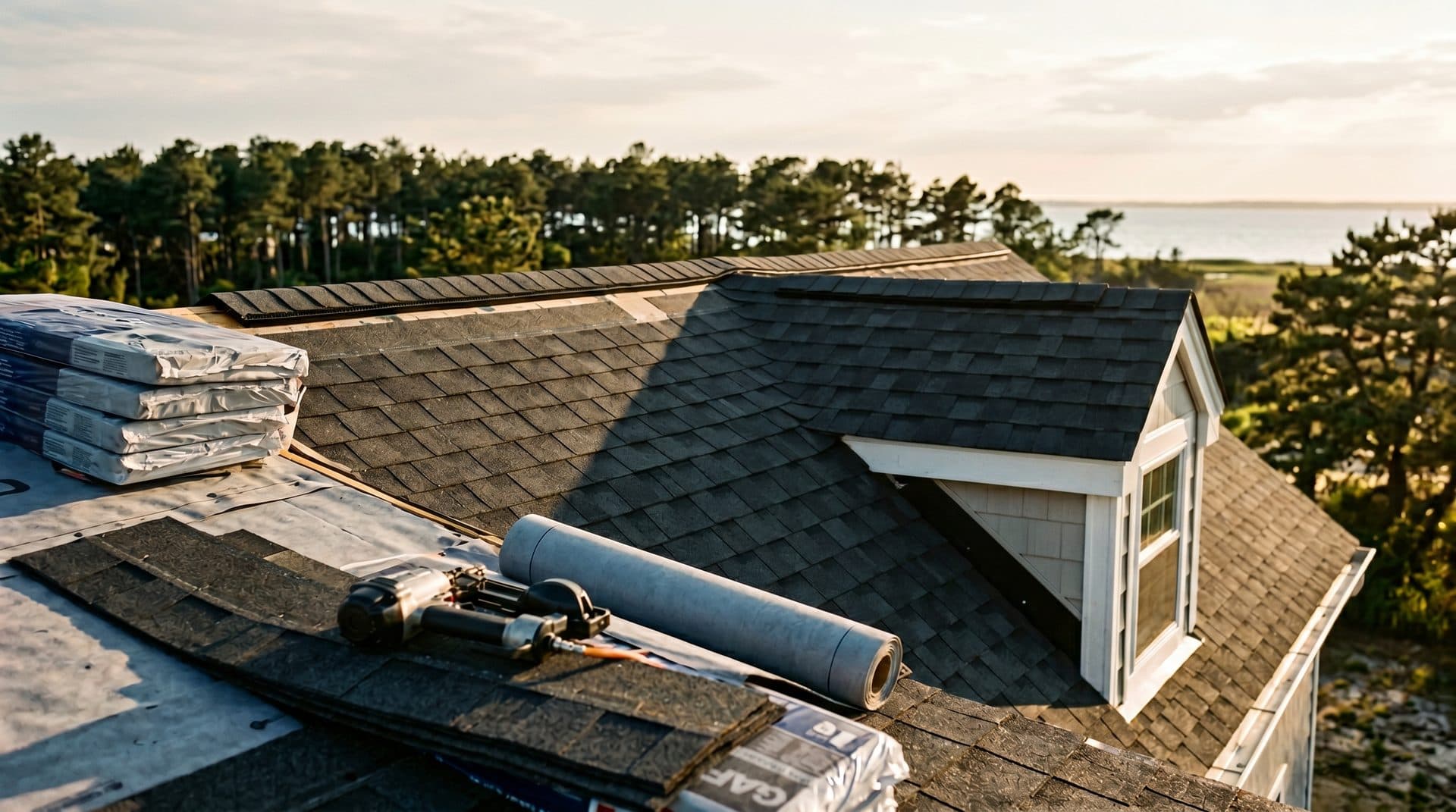
The most common question we get on a free estimate, after the price, is when to do the work. Most homeowners assume summer because that is when the sun is out, or fall because the weather feels mild. The honest answer is more specific than that, and the months you pick can change what you pay, who you get on the crew, how the install actually goes, and what happens to your lawn and your house during the tear-off. After twenty years of replacing roofs across Forked River, Lacey, Bayville, Barnegat, Manahawkin, Toms River, Brick, and up through the Monmouth shoulder towns, we have a pretty clear read on which months are honestly the best and which ones to avoid if you can.
This is not a marketing pitch to book in any particular month. We are working year-round and have the staffing to cover whichever window you pick. The information below is what we tell homeowners who ask us straight up: if you have the choice, which month is actually best for the roof, the install, and your wallet? Here is the month-by-month read for Ocean County and the southern Monmouth coast.
What Actually Determines a Good Month for Roof Replacement
Four things drive whether a month is a good time to replace a roof at the Jersey Shore, and most of the conventional wisdom only looks at one of them.
- Temperature for the shingle. Asphalt shingles seal by softening in heat and bonding to the shingle below. Below about 45 degrees and they will not seal properly until the next warm stretch, which leaves the roof exposed to wind uplift until then. Above about 90 degrees and the shingles scuff easily when walked on, and the crew is working in dangerous heat on a black roof deck.
- Weather window. A roof tear-off has to be buttoned up by end of day. Pop-up afternoon thunderstorms in July or three days of nor'easter rain in November both make the install harder and riskier. The most valuable thing on a roof job is a stretch of dry forecast.
- Crew availability and pricing. Every roofing market has busy season and shoulder season. In Ocean County, roofers are slammed from May through October and lighter from January through March. Busy season prices are usually 10 to 20 percent higher, and the crews are stretched. Shoulder season prices are softer and the same crews are looking for work.
- Storm season. Hurricane and nor'easter season runs roughly June 1 through late November on the coast. Replacing a roof going into a storm season carries more risk than replacing it coming out of one.
Run those four together and a clear shape emerges for which Ocean County months are great, which are workable, and which are honestly the wrong call if you have a choice.
April Through Mid-June: The Best Window, Hands Down
If you are reading this and your roof can wait a few weeks, this is the window we tell our own family to aim for. Late April through mid-June is, on average, the best stretch of the year to replace a roof on the Jersey Shore. Daytime highs land in the 55-to-80 range, which is the temperature band asphalt shingles are designed for. Spring storms are mostly cleared, hurricane season has not started, and the long-range weather windows are predictable enough to plan a clean install.
The other factor is the install quality you actually get in this window. The shingles seal cleanly, the underlayment lays flat, the crew can work full days without stopping for heat or thunderstorms, and the punch-list is easier because everything visible is dry and the lawn is recovering, not baked or muddy. The finish quality on a April-through-mid-June install is genuinely better than the same crew doing the same roof in late July.
The downside is that everybody else figures this out too. April fills up by mid-March on most roofers' calendars. If you want this window in 2027, the call should already be on the books in February or March. If you are reading this in June 2026 and you wanted late spring, you missed it for this year and the next-best windows are below.
Mid-June Through August: Workable, but Watch the Heat
Summer is the busiest stretch of the year for roofers on the shore and it is also the trickiest install conditions. Daytime highs into the high 80s and 90s mean the roof deck surface temperature is well over 130 degrees on a south-facing slope, and asphalt shingles scuff easily under boots at those temperatures. A good crew works in the early morning, breaks during the worst heat, and runs shorter days. A bad crew pushes through the heat to make the schedule and the result shows up later as scuffed shingles, missed nail patterns, and rushed flashing.
The other summer issue is afternoon thunderstorms. Ocean County in July gets pop-up storms with very little warning. A pro crew watches the radar all day and buttons up the roof early if a storm is rolling in. An inexperienced crew gets caught with the underlayment half-on and a deck full of nails, and that is how water gets into the attic during the install itself.
Summer is workable if you are using a crew that has done shore work for years and knows how to manage the heat and the weather windows. It is the worst possible time to take a chance on a low bid from a crew you do not know. Pricing is also at its peak in this window, often 15 to 20 percent above shoulder-season pricing for the same work.
September Through Mid-November: The Second-Best Window
Once the worst of the summer heat breaks and hurricane risk starts dropping in mid-September, the conditions get great again. Late September through about mid-November is the other strong window for roof replacement in Ocean County. Temperatures land back in the 50s and 60s, the shingles seal cleanly, the days are still long enough for a one-to-two-day install, and the leaves have not fully come down yet so the cleanup is manageable.
The catch in fall is that you are racing two clocks. First, the temperature drops fast in November on the coast. By Thanksgiving, daytime highs can be in the low 40s, which is below the shingle seal threshold. Second, hurricane season technically runs through November 30 and the late-season nor'easter is real. A roof scheduled for early October can absolutely get done in a good week of weather. A roof scheduled for mid-November has a real chance of getting bumped by a storm.
The other consideration on a shore home is your fall schedule. Fall is when the second-home owners in Manasquan, Spring Lake, Bay Head, and LBI are closing up the house. We work on closed houses all the time, but if you want to be there for the install (which we recommend for at least the first morning), match the schedule to when you can actually be on site.
Pricing in this window is usually mid-band, neither the peak of summer nor the trough of winter. Crews are still busy but starting to look at the winter schedule, so there is more flexibility.
Late November Through February: The Worst Window for Most Homeowners
This is the stretch we tell homeowners to avoid if there is any honest choice. The conditions on the shore in deep winter are wrong for asphalt shingles in three specific ways.
- The shingles will not seal. Below about 45 degrees, the asphalt seal strip does not activate. The roof goes on, looks fine, and sits unsealed through the rest of winter waiting for a warm stretch. During that period, the roof is at much higher risk of wind uplift. Most pros will hand-seal each shingle in cold-weather installs, which adds labor cost and is still not as good as a roof that self-sealed in 70-degree weather.
- The deck and the crew are dealing with weather. Ice on the roof deck, snow that has to be cleared before tear-off, and short daylight hours all compress what a crew can get done in a day. The install drags out, the roof spends more time open to weather, and the risk profile goes up.
- Cleanup is hard. A January roof replacement on a frozen lawn is what it sounds like. Nails get pressed into frozen ground and are harder to magnet up in spring when the thaw exposes them. Tarps freeze stiff. Dumpster removal gets complicated by the parking restrictions in shore towns.
The exception is an active leak that cannot wait. Roof replacement in deep winter is absolutely doable in an emergency and we do it every year for homes that had a real failure. But if the roof is just old or showing the early warning signs we covered in our roof warning signs guide, waiting until March is usually the better call than rushing the install in January.
March: The Shoulder Window With Best Pricing
March is the most underrated month for roof replacement on the shore. It is shoulder season, so crews are hungry and pricing is at its softest of the year, often 10 to 15 percent below peak. Temperatures climb steadily through the month from the upper 40s into the 60s by the end. By the second half of March the shingles will seal properly on most warm afternoons.
The catch with March is weather predictability. Early March in Ocean County can still throw a nor'easter, and the back-and-forth between 50-degree sun and 35-degree rain makes scheduling tighter. We tell homeowners targeting March to expect some flexibility on the install date. The job gets done in March, but maybe not on the specific Tuesday it was scheduled for.
If your roof can hold through the end of February and you want to get it done before the spring rush, late March is the sweet spot. Better pricing than April, conditions usable enough for a clean install, and the new roof is fully sealed and storm-ready before the busy season starts.
Most of the above assumes you are doing a planned replacement on an aging roof. Storm damage and insurance claim replacements are different. If a storm has damaged the roof, the timing question is moot, you are replacing now. The bigger questions are which contractor handles it and how the claim gets filed, and we covered both in our [insurance claim walkthrough](/blog/roof-storm-damage-insurance-claim-nj). The short version: do not let a storm-chaser who showed up the morning after talk you into an emergency replacement at peak pricing. A local roofer who lives in Ocean County and will be answering the phone next winter is the right call regardless of the time of year.
The Honest Order of Operations
If you want the simplest version of the above, this is the priority order we would use ourselves.
- First choice: late April through mid-June. Best conditions, best install quality. Book it in February.
- Second choice: mid-September through mid-October. Almost as good, more flexibility, mid-band pricing.
- Third choice: late March. Best pricing of the year, conditions are usable, schedule has some flex.
- Workable if needed: mid-June through August. Make sure the crew is experienced with shore summer heat and the radar.
- Avoid if possible: late November through February. Only if the roof has actually failed.
And the universal advice regardless of month: book early, use a local crew who will still be here in three years, and do not chase the lowest bid into a substandard install. The whole reason we get hired to tear off and replace roofs that are only ten years old is that the original install was rushed, the seal failed, or the crew never came back to fix the punch list. The roof outlives the install conditions by decades, but only if it goes on right in the first place.
How Home Pro Handles Scheduling Across the Year
We run year-round, with the bulk of our work concentrated in the April-through-October window where the install conditions are right. We do not push homeowners into install dates that fight the weather, we are honest about which months are the best fit for your specific situation, and we will tell you straight if a roof can wait three months for a better window. We are GAF-certified, we live and work in Ocean and Monmouth County, and we have been doing this for over twenty years across Forked River, Lacey, Bayville, Barnegat, Manahawkin, Toms River, Brick, Howell, Wall, Manasquan, and the LBI corridor.
If your roof is on the list to replace and you want the honest read on when to schedule it, reach out for a free inspection. We will tell you whether the roof can wait for a better window, what that window costs versus rushing it now, and what to budget for the install when we get there.